RF Drone Detection: Definition & Pros and Cons
 The Skylock Team
Abstract
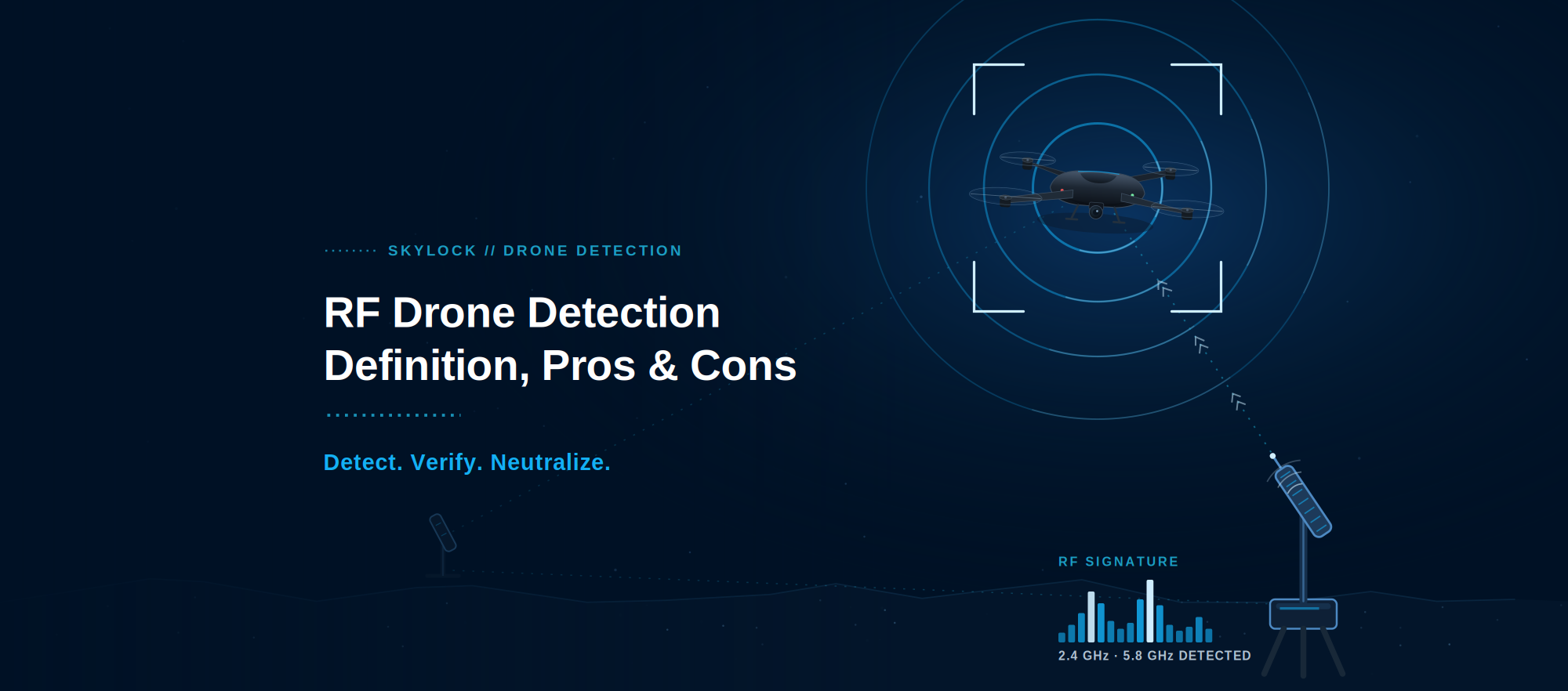
RF drone detection is a passive counter-UAS method that identifies potential drone activity by monitoring radiofrequency signals, including control links, telemetry, video downlinks, and Remote ID broadcasts where applicable.
This guide examines:
- the operational benefits
- technical constraints
- vendor evaluation criteria
Low-altitude drones create a difficult security problem. They are small, fast, affordable, and often hard to attribute quickly, especially when the operator is located far from the protected site. For critical infrastructure, airports, government facilities, and defence environments, this compresses the timeline between detection, verification, and response.
Despite the growth of drone-related risk, many high-value sites still lack comprehensive, layered counter-UAS protection. Aerospace intelligence assessments report that 93% of nuclear facilities, 90% of major oil refineries, and 63% of top US airports operate without layered counter-UAS coverage.
A ground fence can protect the perimeter, but it cannot provide low-altitude airspace awareness. For security teams evaluating RF drone detection, the real question is how quickly they can reduce uncertainty, verify the threat, and feed actionable information into a wider counter-UAS workflow.
What is RF drone detection?
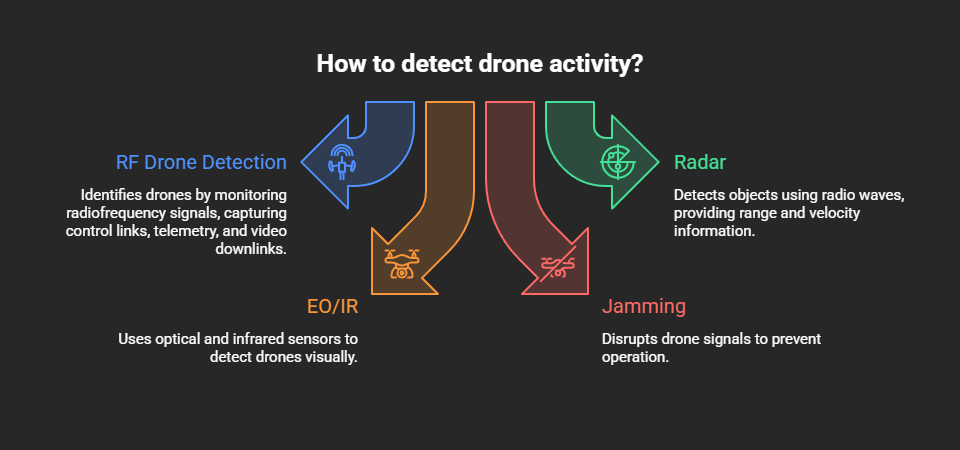
Radio Frequency (RF) drone detection is a passive method that identifies potential unmanned aircraft system (UAS) activity by monitoring radiofrequency signals. It captures control links, telemetry, and video downlinks, and detects Remote ID broadcasts where applicable. Instead of relying on optics, this technology identifies threats by recognising known signal characteristics and navigation-related emissions, depending on the system design.
It is essential to understand that this technology is not radar, not EO/IR, and not a tool for jamming. It provides detection and identification based on the presence and characteristics of the signal. While Remote ID can support identification efforts when signals are present and receivable, it does not replace dedicated detection systems. Operational success depends on context, as compliance requirements vary by jurisdiction. Furthermore, your ability to act on any specific detections remains strictly dependent on local legal authorities and your established rules of engagement.
What RF detection can confirm vs what it can’t
RF detection provides actionable intelligence, yet it has distinct operational boundaries that security teams must recognise.
This technology can confirm the presence of a drone or its control link, often identifying the likely protocol or brand, providing a direction or sector, and sometimes offering a location estimate, depending on the system architecture.
However, the technology cannot guarantee visual confirmation of the target or identify a specific payload. It is also unable to detect drones flying in fully autonomous or emissions-silent modes, as these flights lack the necessary signal transmissions. Importantly, RF detection does not equate to drone neutralisation. It functions as a foundational sensor to be integrated into a larger framework, not as a standalone mitigation solution.
How RF drone detection works in the field
RF drone detection turns radio-frequency data into operational awareness through a defined sequence.
- Spectrum Sensing: The system monitors the wideband spectrum to detect electromagnetic activity.
- Pattern Detection: It scans for signals that match known UAS communication patterns.
- Classification: Using signature libraries and heuristics, the system determines the likely drone protocol or brand.
- Geolocation: The system uses direction-finding, TDOA, or multi-sensor correlation to locate the target, which is essential for countering a drone swarm.
- Verification: The process automatically cues sensors, such as EO/IR cameras, for visual confirmation.
- Reporting: The system pushes data into your C2 or security operations workflow.
Outputs security teams actually use
Actionable RF outputs are critical because they dictate how security teams manage threats in real time. Furthermore, this structured data ensures reliable incident logs, which are vital for thorough post-event investigations and refining ongoing site security strategies.
| Output | Operational Benefit |
| Alert Confidence | Enables faster, more accurate threat triage |
| UAS Type / Protocol | Assists in identifying the specific threat profile |
| Bearing & Track Estimates | Provides immediate situational awareness and location data |
| Time-Stamped Events | Creates precise, reliable logs for incident investigations |
| Operator Prompts | Reduces manual cognitive burden on security teams |
Why teams choose RF drone detection (Pros)
RF drone detection offers distinct operational advantages, especially as an early-warning and identification layer within a broader counter-UAS architecture.
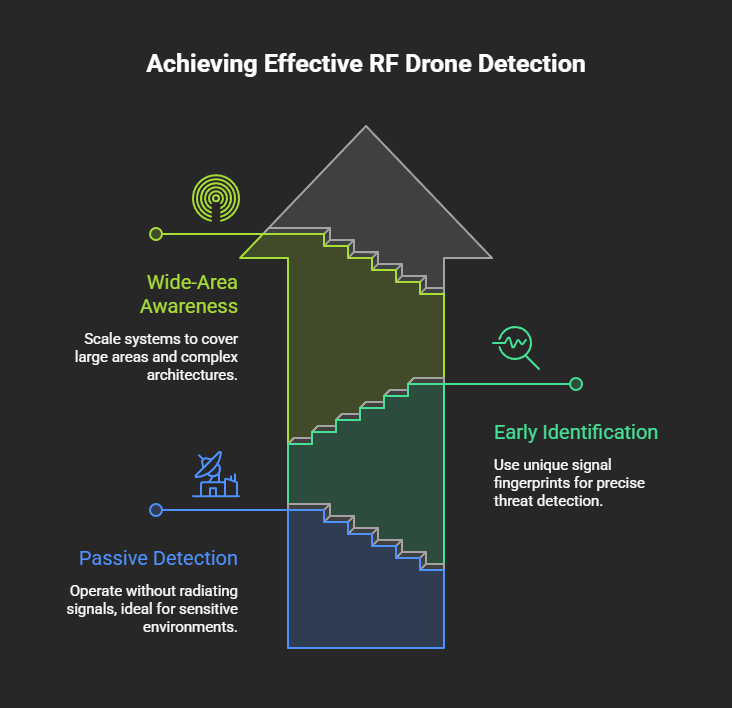
Passive detection that supports early warning
RF detection operates passively, meaning it does not radiate signals. This attribute makes it suitable for sensitive environments where maintaining a low electromagnetic footprint is a priority. It does not transmit energy to operate, thereby avoiding adding to the local interference profile while providing continuous monitoring.
Strong for early identification when tuned and maintained for the site
Well-managed RF systems use unique signal fingerprints to distinguish drones from ambient noise. Because performance hinges on site baselining and alert thresholds, you have to stay on top of configuration management. Fail to tune these settings in congested areas, and you will be buried in unnecessary alerts. Consistent maintenance is the only way to keep your team focused on actual drone activity.
Scales well for wide-area awareness
RF detection systems scale effectively to cover distributed sites, long perimeter systems, and complex layered security architectures. By integrating into existing workflows, RF detection provides essential situational awareness across large areas. It is important to note that actual performance remains highly dependent on site-specific conditions, including local spectrum congestion, physical clutter, optimal antenna placement, and the nature of the threat profile.
Where RF drone detection struggles (Cons and limitations)
RF detection is a powerful sensor, but it has technical blind spots you must account for in your security architecture.
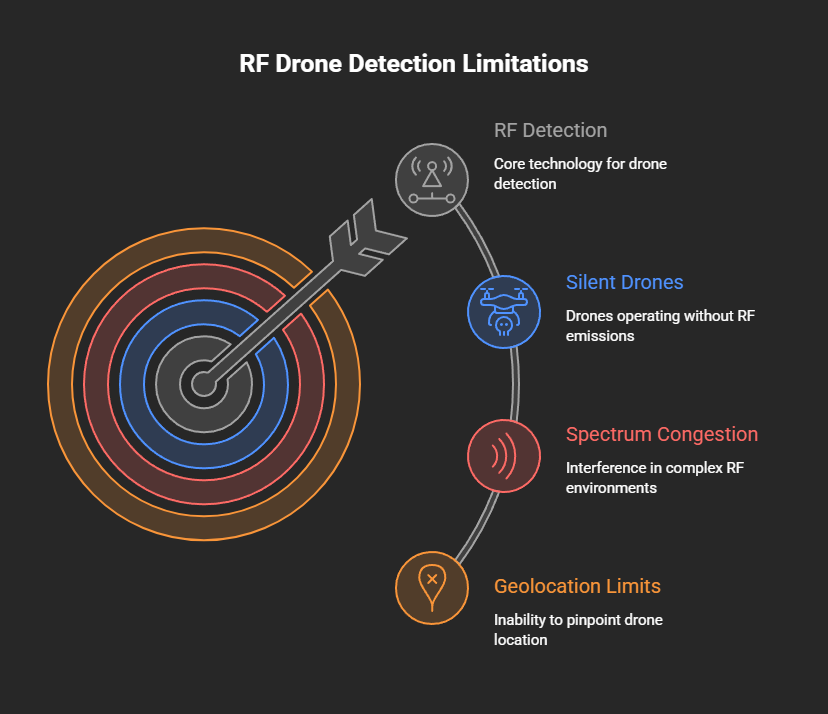
“Silent” or autonomous drones
RF-only coverage can degrade when emissions are absent or atypical. This risk increases significantly when unmanned aircraft systems (UAS) fly pre-programmed routes or operate in non-emitting modes. Furthermore, coverage may falter if links are intermittent, operate at very low power, or utilise novel, proprietary waveforms that fall outside the system’s established signature library. Although some autonomous missions might transmit occasionally, operators should never assume that an RF signal will always be present for detection.
Spectrum congestion and contested RF environments
RF systems often struggle in complex environments such as airports, ports, or dense urban areas. They often encounter significant interference, overlapping emitters, and multipath effects. The operational impact of these conditions is an increased likelihood of nuisance alerts. To maintain a reliable security posture, teams must ensure that signal filtering is well managed and consistently updated to account for these challenging RF conditions.
Geolocation and attribution limits
RF detection technology can provide bearing or sector information. Still, it does not always provide a precise location estimate without multi-node setups and high-quality geometry. Additionally, there is a clear distinction between detection and attribution. Detecting a radio link confirms communication, but it does not prove the operator’s intent or identify a specific payload.
RF detection’s role in a layered counter-UAS architecture
RF detection is most effective when integrated into a comprehensive, layered counter-UAS (C-UAS) strategy rather than as a standalone solution. Combining multiple sensing technologies reduces uncertainty and provides a complete operational picture, which aligns with modern infrastructure security best practices for protecting high-risk sites.
Detect, Verify, Respond Framework
Security succeeds through a Detect-Verify-Respond framework. RF sensors act as the trigger, cueing radar or Electro-Optical (EO) systems to scan specific sectors. EO then provides the visual proof needed to confirm a threat. Once validated, you execute response actions in accordance with site safety constraints and your Rules of Engagement. This multi-layer approach, supported by open-architecture integration, facilitates operator-light workflows that prioritise clear, actionable intelligence without overclaiming system capabilities.
Integration into C2/C4I/PSIM workflow
Integration is the bridge between raw data and actionable security. A high-performing Command and Control or PSIM setup unifies your sensor network into a single, cohesive workflow. This level of integration is designed to minimise “swivel-chair” operations, where staff must manually manage disparate systems. In fact, for procurement teams, the quality of system integration often dictates operator workload more significantly than the raw performance metrics of an individual sensor.
| Feature | Pro | Con |
| Passive Monitoring | Passive monitoring; does not transmit to detect | Limited against silent/autonomous threats |
| Early Warning | Rapid identification of UAS links | Performance drops in congested spectrum |
| Layered Integration | Enhances C2/PSIM workflows | Requires complex multi-sensor geometry |
Procurement and evaluation checklist
Selecting the right RF detection system requires a rigorous evaluation process that prioritises operational utility over raw technical specifications. Security teams should look beyond marketing claims and focus on how a system performs in their specific environment and within their existing security architecture.
Questions to ask vendors during trials
To ensure the system meets your site requirements, challenge vendors with these key questions during the trial phase:
- Which drone protocols or signatures are supported, and what is the update frequency?
- How does the system maintain performance in congested spectrum environments or areas with high interference?
- What does “classification confidence” represent in an operational context?
- Which geolocation method is used, and what are the specific deployment requirements regarding node count, spacing, and calibration?
- How are alerts prioritised to effectively reduce operator overload?
- How does the system integrate with existing C2, C4I, PSIM, or VMS infrastructure, and what safeguards maintain workflow continuity during outages, degraded connectivity, or system updates?
- What is the sustainment model, including training, updates, and lifecycle support?
- How is the protocol library updated? What is the validation process, and what is the plan for maintaining classification accuracy over the system’s entire lifecycle?
Vendor evaluation should also include third-party risk governance. RF detection systems may connect to C2, C4I, PSIM, VMS, SOC, or networked security environments, so procurement teams need to assess more than sensor performance. They should review vendor ownership, support responsibilities, update processes, data handling, access controls, incident response procedures, and lifecycle obligations as part of a broader third-party risk management framework.
Deployment fit factors
Evaluate the system based on your unique site type, such as an airport, port, or base. Consider the impact of local terrain, physical clutter, and the electromagnetic spectrum environment on your specific Concept of Operations (CONOPS). Finally, always conduct stress testing in realistic conditions to ensure the system is fit for purpose.
Commonly Asked Questions about RF Drones
Is RF drone detection legal to use?
Legal authorities on RF drone detection and mitigation differ significantly across jurisdictions. Passive monitoring is often treated differently from active interference, but compliance still depends on the system’s specific functions, including how it detects, processes, stores, and shares RF data. Before testing, purchasing, or deploying any counter-UAS technology, organisations should review local aviation, telecommunications, privacy, surveillance, and security laws, and align operations with approved rules of engagement (ROE). Legal counsel should also confirm that the system does not rely on unauthorised jamming, spoofing, interception, or interference with protected spectrum. During procurement, teams should assess vendor compliance practices and update processes, data handling, and lifecycle support to reduce long-term legal and operational risks.
Can RF detection find drones that aren’t transmitting?
RF detection is inherently limited when dealing with “silent” or autonomous drones. If a drone operates on pre-programmed routes without radio frequency emissions, RF-only coverage will likely fail to detect it. Because you cannot assume RF signals will always be present, these sensors must be part of a layered architecture. Integrating complementary sensors, such as radar or EO/IR, is essential to cover these critical blind spots.
Is RF detection better than radar?
Comparing RF detection and radar is a mistake because they solve different problems. RF detection identifies a drone’s protocol, brand, and pilot location, providing the “what” and “who,” but it fails against radio-silent or autonomous threats. Radar detects the physical object, offering the “where” and “how fast” required to track non-emitting targets. You need both to close the loop. Relying on a single sensor creates a security gap, which is why a drone detection radar is a standard component of any robust layered architecture.
Sharpening Your Counter-UAS Strategy
RF drone detection provides essential early warning and rapid identification of UAS activity, yet it remains subject to predictable blind spots in the presence of silent or autonomous flight. Because these gaps exist, achieving genuine security at scale requires moving beyond individual sensors to focus on layered detection strategies and deep integration into your existing operational workflows.
This multi-sensor, operator-light approach is what transforms raw data into a reliable defensive capability. If you are currently assessing your counter-UAS detection options, now is the time to ensure your architecture is built for the complexities of the modern threat environment. Talk to a Skylock expert today to refine your evaluation criteria.