Top 10 Anti-Drone Systems by Category
 The Skylock Team

Abstract
Anti-drone systems use sensors and command software to detect, track, verify, and support authorised responses to drones. Buyers should distinguish complete architectures from components requiring integration.
| Category | Main use case |
| Multi-layer platforms | Coordinate sensing, verification, and response through shared command software. |
| Radar-led systems | Track physical targets, including drones without supported RF emissions. |
| RF and protocol-led systems | Identify supported signals and locate drones or operators. |
| EO/IR verification | Inspect targets using optical and thermal imagery. |
| Tactical and redeployable systems | Protect temporary sites or support mobile missions, depending on configuration. |
A drone alert leaves several decisions unresolved. Operators still need to establish what is flying, maintain its track, assess the risk, and decide what action they can take. Procurement teams buying an anti-drone system need to evaluate that entire sequence, including the handoffs between equipment, software, and people.
The Federal Aviation Administration receives more than 100 drone sighting reports near airports each month. These are reported sightings, rather than confirmed attacks, but they illustrate the verification workload facing airport and airspace security teams.
The ten solutions below address different parts of that operational problem. They are grouped into five categories so you can compare complete platforms separately from radar, RF intelligence, optical verification, and redeployable capabilities. A suitable shortlist starts with the mission and the authority to respond.
Top picks by category
- Recommended for end-to-end multi-layer architecture: Skylock Multi-Layer Counter-UAS
- Recommended for compact radar-led early warning: Echodyne EchoGuard
- Recommended for RF signal intelligence: Rohde & Schwarz ARDRONIS
- Recommended for optical and thermal verification: Teledyne FLIR Counter-UAS
- Recommended for portable and vehicle-based tactical operations: DroneShield
End-to-end multi-layer Counter-UAS platforms
This category suits organisations procuring a coordinated detection, verification, and response architecture. For critical infrastructure protection, that architecture must connect airspace monitoring with the site’s wider security and response procedures. Assess how the command layer combines sensor reports, who owns the integrations, and what operators must do when an alert arrives.
| Solution | Best fit | Primary value | Key consideration |
| Skylock | Defence, government, infrastructure, and airspace protection | Multi-layer sensing and open C4I architecture | Specify the sensors, interfaces, and authorised response options included. |
| Dedrone | Fixed sites and security operations teams | Multi-sensor command software with hosting choices | Confirm deployment dependencies, sensor compatibility, and data requirements. |
| DroneShield | Organisations spanning fixed, mobile, and dismounted missions | Integrated command software and a broad hardware portfolio | Different configurations provide different sensing and response capabilities. |
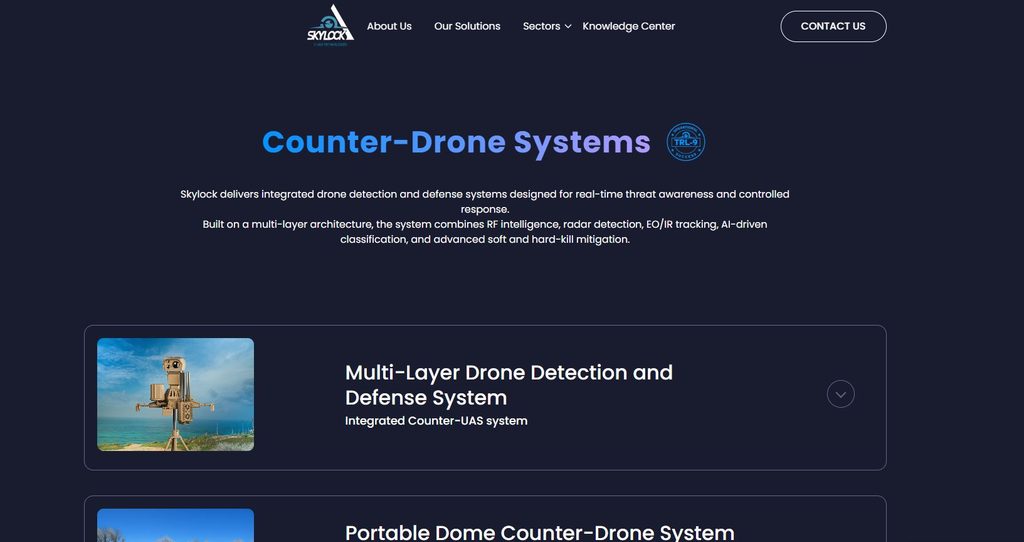
1. Skylock Multi-Layer Counter-UAS
Best for: Defence, government, and infrastructure buyers seeking a configurable architecture across fixed and mobile deployments.
Skylock Multi-Layer Counter-UAS brings detection, verification, and authorised response into a common operational architecture. Its value for procurement lies in connecting those functions with existing command infrastructure.
Key capabilities:
- Radar, passive RF, EO/IR, and acoustic sensing options.
- Multi-sensor fusion and AI-assisted classification.
- C4I with EO/IR auto-cueing and tracking.
- SDK/API-ready third-party integration and configurable mitigation options.
Strengths and considerations: The modular approach supports different mission requirements. Buyers should require an integration matrix and acceptance criteria for the proposed configuration. The portfolio’s breadth does not mean every installation includes every sensor or effector. Performance and response remain dependent on site conditions, legal authority, and rules of engagement.
Pricing and availability: Publicly marketed; pricing not publicly disclosed. Configuration, delivery, and export eligibility require supplier confirmation.
2. Dedrone
Best for: Fixed-site security teams that need multi-sensor airspace monitoring within an established operations function.
Dedrone centres its integrated offering on DedroneTracker.AI. The platform combines RF, radar, and pan-tilt-zoom camera inputs, with countermeasure integration where authorised. Dedrone is part of Axon.
Key capabilities:
- Multi-sensor command and control with threat prioritisation.
- Automated camera interrogation and visual tracking.
- Cloud-managed or on-premises hosting.
- RF analysis and camera-based forensic evidence capture.
Strengths and considerations: Hosting choices make it relevant where data handling and network architecture influence procurement. Include hosted services, remote access, and third-party connections in your continuous threat exposure management programme. Evaluate the proposed sensor package against the actual threat profile. RF-derived identification and location information depend on supported signals; camera confirmation requires suitable visibility. Ask how the system handles lost tracks and unavailable sensors.
Pricing and availability: Publicly marketed; pricing not publicly disclosed. Confirm the current software, hardware, and support scope in the quotation.
3. DroneShield
Best for: Military, public safety, and infrastructure organisations procuring several deployment types within one vendor portfolio.
DroneShield offers fixed-site, on-the-move, expeditionary, and dismounted products. DroneSentry-C2 provides the command layer for integrated deployments, combining RF, radar, and optical sensor information.
Key capabilities:
- DroneSentry-C2 sensor fusion and operational display.
- RF detection and signal classification.
- Radar and camera integration.
- Portable detection devices and electronic countermeasures where authorised.
Strengths and considerations: The portfolio supports organisations with both permanent and field requirements. However, a handheld detector, a vehicle-mounted unit, and a multi-sensor site installation provide different coverage. Specify what must operate while moving, which sensors provide location information, and how updates reach equipment deployed away from reliable networks.
Pricing and availability: Publicly marketed; pricing not publicly disclosed. Request configuration-specific training, software, warranty, and sustainment costs.
Radar-led anti-drone systems
Radar belongs on the shortlist when buyers need a physical target track, including against drones that do not emit a supported control signal. Procurement should focus on track continuity and useful warning time under local clutter conditions. Radar still needs verification and command integration.
| Solution | Best fit | Primary value | Key consideration |
| Echodyne EchoGuard | Compact radar integration and temporary deployments | Precision tracking with small size, weight, and power requirements | Validate target tracks and coverage against local terrain and clutter. |
| Meteksan Retinar FAR-AD | Military and critical-site surveillance | Radar developed for mini and micro drone detection | Confirm sensor handoff, outputs, and deployment requirements. |
4. Echodyne EchoGuard
Best for: Integrators adding compact radar-based airspace awareness to a wider security system.
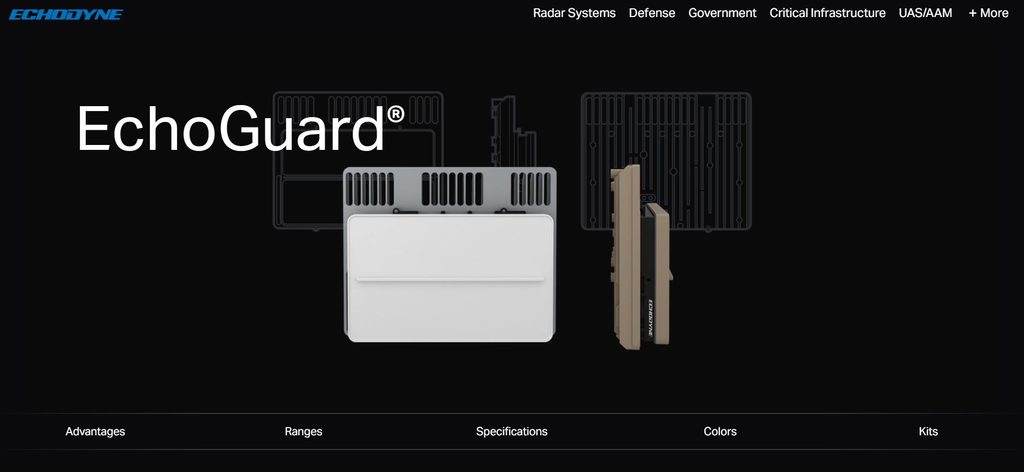
Echodyne EchoGuard is a short-range electronically scanned radar. Its compact form makes it relevant where equipment footprint and power demand constrain deployment.
Key capabilities:
- Air and surface target tracking.
- Bearing, range, elevation, and trajectory information.
- Compact hardware for portable installations.
- Integration support for downstream security systems.
Strengths and considerations: EchoGuard is a radar layer, so buyers must budget for verification, command software, and any response capability. During evaluation, measure whether its output lets the receiving system acquire and retain the target. A detection point that never becomes a usable track has limited operational value. Terrain, mounting position, target radar signature, and clutter affect results.
Pricing and availability: Publicly marketed; pricing not publicly disclosed. Include software support and integration work in the requested cost breakdown.
5. Meteksan Retinar FAR-AD
Best for: Military, perimeter, border, and critical-site programmes requiring dedicated drone-detection radar.
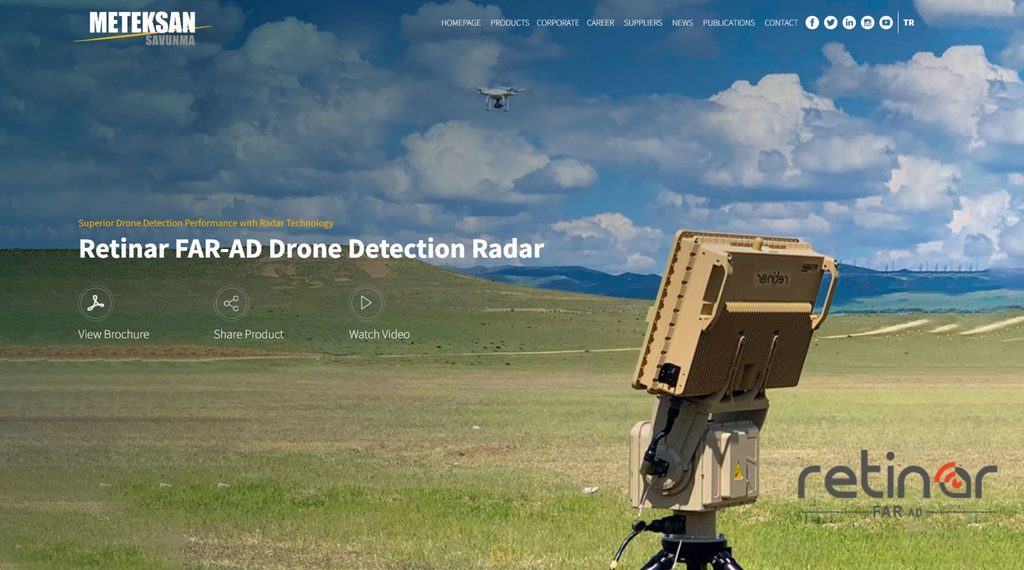
Meteksan Retinar FAR-AD was developed for mini and micro unmanned aircraft threats. It automatically scans low-altitude airspace and presents target information to operators.
Key capabilities:
- Automatic scanning of wide areas and low-altitude airspace.
- Drone detection and tracking.
- Target location, distance, speed, and direction display.
- Target analysis supporting classification.
Strengths and considerations: Its dedicated radar role makes it a candidate for a layered surveillance architecture. Procurement teams should establish how target data passes into the selected command system and cues optical verification. Request evidence using representative drones and local clutter, together with installation, maintenance, and operator requirements.
Pricing and availability: Publicly marketed; pricing not publicly disclosed. Confirm the quoted radar variant, interfaces, and associated support package.
RF and protocol-led anti-drone systems
RF drone detection can add signal identification and operator-location information that radar alone cannot provide. These systems suit buyers who need to understand supported drone communications, particularly in urban and public safety environments. Coverage depends on the target’s emissions, supported protocols, and spectrum conditions.
| Solution | Best fit | Primary value | Key consideration |
| Rohde & Schwarz ARDRONIS | RF monitoring and direction finding | Modular signal detection, localisation, and disruption options | Capabilities differ substantially between configurations. |
| Sentrycs | Supported commercial-drone threats in sensitive environments | Protocol-based identification and non-jamming mitigation | Verify model and firmware support, link conditions, and response authority. |
6. Rohde & Schwarz ARDRONIS
Best for: Security agencies and integrators seeking a defined RF monitoring and direction-finding capability.
Rohde & Schwarz ARDRONIS is a configurable product family. Its published comparison distinguishes detection from drone localisation, pilot localisation, and active countermeasures.
Key capabilities:
- Detection and classification of supported drone and controller signals.
- Drone and pilot localisation in relevant configurations.
- Wi-Fi detection and disruption options.
- Open interfaces for multi-sensor integration.
Strengths and considerations: The modular structure helps buyers match functions to requirements, but the family name alone does not define the purchased capability. For example, detection does not automatically include pilot localisation. Non-emitting drones remain a coverage gap for an RF-only architecture. Active disruption requires separate legal and operational assessment.
Pricing and availability: Publicly marketed; pricing not publicly disclosed. Request an itemised configuration and update-service scope.
7. Sentrycs
Best for: Urban, public safety, and critical-site teams evaluating protocol-based control of supported drones.
Sentrycs uses RF-based protocol analysis for detection, tracking, identification, and mitigation. Its non-jamming approach is relevant where buyers need to examine alternatives to broad RF disruption.
Key capabilities:
- Passive RF detection and drone identification.
- Drone and operator tracking for supported targets.
- Integrated command and control.
- Cyber takeover and controlled landing options where supported and authorised.
Strengths and considerations: Protocol-derived information can help distinguish individual aircraft and support controlled outcomes. Buyers should request a current compatibility matrix and demonstrations using representative firmware and link states. A non-jamming method still requires legal authority and site-specific safety evaluation. Unsupported protocols and non-emitting autonomous aircraft require complementary detection and response provisions.
Pricing and availability: Publicly marketed; pricing not publicly disclosed. Confirm support coverage, deployment configuration, and update arrangements.
EO/IR visual verification and AI-assisted tracking
Electro-optical and infrared systems help operators inspect an object, assess visible characteristics, and maintain visual tracking. This category suits buyers improving the verification stage of drone detection and tracking. Assess camera cueing and image usability under expected lighting, weather, and viewing geometry.
| Solution | Best fit | Primary value | Key consideration |
| Teledyne FLIR Counter-UAS | Fixed and mobile multi-sensor verification | EO/IR sensing within broader surveillance systems | Compare the specific configuration and camera performance. |
| Walaris AirScout | Automated optical detection and tracking | AI-supported optical systems with integration options | Image quality, visibility, and camera coverage set practical limits. |
8. Teledyne FLIR Counter-UAS
Best for: Buyers requiring EO/IR verification within an integrated fixed or mobile surveillance installation.
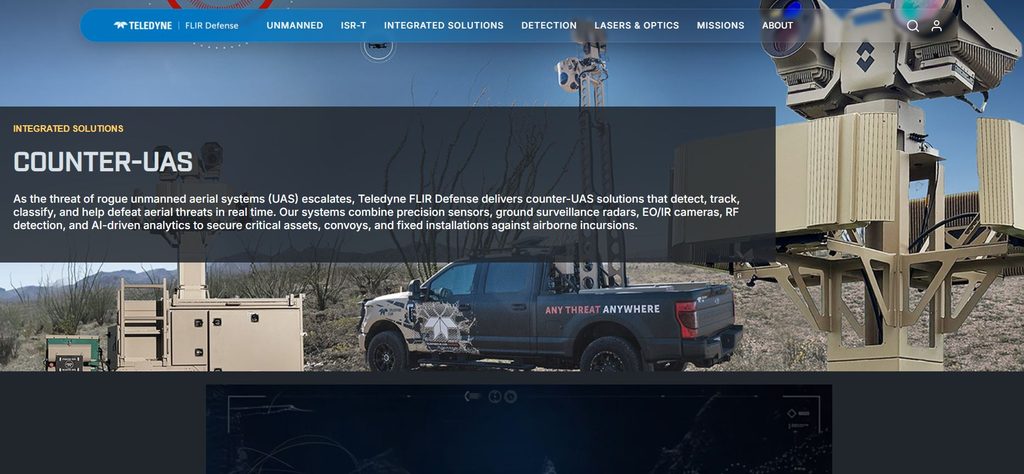
Teledyne FLIR Counter-UAS includes multi-sensor systems combining cameras, radar, RF detection, and analytics. Its portfolio extends beyond optical verification, but that sensing capability gives it a clear place in this category.
Key capabilities:
- EO/IR cameras for visual and thermal observation.
- Radar and RF sensing within integrated configurations.
- Analytics supporting detection, tracking, and classification.
- Fixed and mobile options, including Argus XL and LVSS configurations.
Strengths and considerations: Buyers can evaluate verification alongside the wider sensor installation. Distinguish detecting an object from obtaining enough image detail to support a decision. Camera performance depends on target size, distance, atmospheric conditions, line of sight, and cueing quality. Thermal sensing does not remove those constraints.
Pricing and availability: Publicly marketed; pricing not publicly disclosed. Confirm the product configuration and included response functionality.
9. Walaris AirScout
Best for: Organisations seeking automated optical drone detection, classification, and tracking.
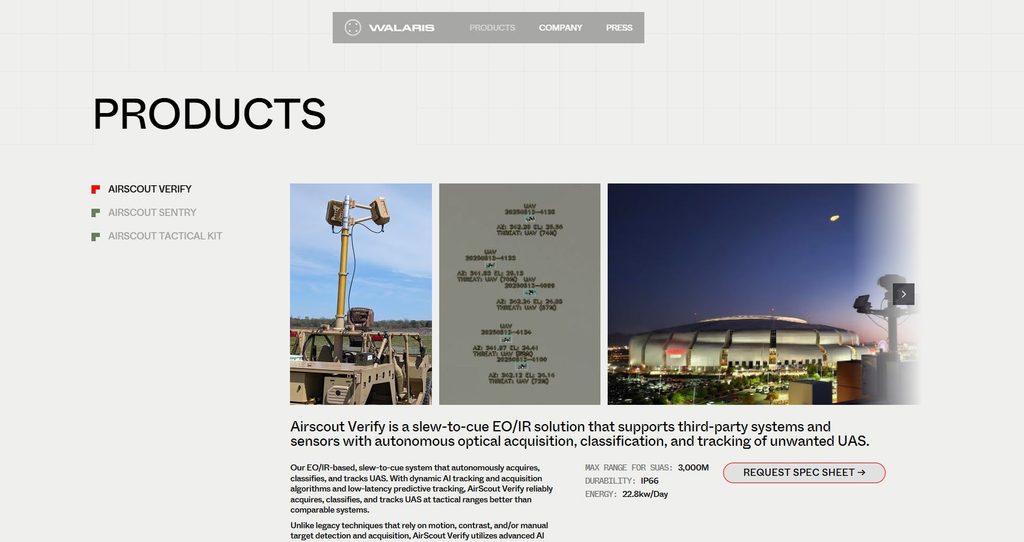
Walaris AirScout includes optical detection systems such as AirScout Sentry. Walaris describes deployments combining cameras, computing, and AI software, with options to integrate into wider sensor architectures.
Key capabilities:
- EO/IR-based detection and acquisition.
- Automated classification and tracking.
- Real-time operator alerts.
- Open architecture and API-based integration.
Strengths and considerations: AirScout can provide a dedicated optical capability or work within a multi-sensor system. Existing camera compatibility should be verified rather than assumed. Ask whether the proposed configuration can search the required airspace, retain tracks through changing backgrounds, and provide useful imagery. Optical detection alone does not establish an authorised mitigation capability.
Pricing and availability: Publicly marketed; pricing not publicly disclosed. Confirm camera, computing, software, and integration scope.
Tactical, mobile, and rapidly deployable anti-drone systems
This category covers equipment brought to the mission, including temporary sites and changing protection requirements. Separate systems that operate during movement from those transported and installed before use. Setup effort, power, communications, ruggedisation, and operator demand determine practical suitability.
| Solution | Best fit | Primary value | Key consideration |
| OSL Technology | Temporary sites and redeployable airspace monitoring | Layered sensing with shared command and responder information | Verify setup requirements and whether the configuration supports operation while moving. |
10. OSL Technology Counter-Drone Systems
Best for: Airports, infrastructure operators, and event teams requiring rapidly redeployable coverage.
OSL Technology Counter-Drone Systems combine layered sensing with FACE command and control. OSL, a Terma Group company, explicitly offers rapidly redeployable units alongside fixed installations.
Key capabilities:
- Radar, RF, optical, and acoustic sensor integration.
- FACE multi-sensor fusion and operational display.
- Responder tablets sharing situational information.
- Site-appropriate alerting and inter-agency response guidance.
Strengths and considerations: OSL fits this category through redeployment and temporary-site protection. That does not establish suitability for every convoy or dismounted mission. Request measured setup time, crew requirements, power and network dependencies, and coverage after relocation. Define who maintains surveillance while equipment moves between locations.
Pricing and availability: Publicly marketed; pricing not publicly disclosed. Request the redeployable configuration’s full equipment and service requirements.
How we selected and compared these anti-drone system solutions
We reviewed official product pages and public vendor documentation on 22 October 2026. This comparison uses public research; it does not report hands-on testing, laboratory benchmarks, or operational trials.
Each solution has an official public offering relevant to government, defence, infrastructure, or public safety procurement. We assigned each to one primary category and compared mission fit, sensing role, verification, integration, deployment, operator requirements, support, and response constraints.
Public marketing confirms an offering is actively promoted. It does not confirm delivery schedules, export eligibility, or suitability for a particular site. We have avoided range rankings because target profiles, terrain, clutter, spectrum conditions, and test methods differ. Pricing statements reflect the reviewed pages, rather than private quotations.
How to choose the right anti-drone system
Define the operational outcome before selecting counter-drone technology categories. Use the following sequence to make supplier proposals comparable.
| Decision | What procurement should establish |
| Mission | Protected assets, operating hours, acceptable disruption, and required warning time. |
| Threat profile | Representative drones, communications behaviour, approach conditions, and simultaneous-target expectations. |
| Environment | Terrain, structures, clutter, lighting, weather, spectrum, power, and communications. |
| Legal authority | Permitted collection and response methods, approval roles, rules of engagement, and safety constraints. |
| Operational concept | Who monitors, verifies, escalates, responds, and records the incident. |
| Technology selection | Sensor coverage, command integration, deployment model, acceptance tests, and sustainment. |
For fixed sites and critical infrastructure, test persistent coverage, false-alarm workload, evidence capture, and handoff into existing video management, security operations, or dispatch systems.
For airports and major events, prioritise verification speed and coordination without unnecessary disruption. Evaluate who receives the alert and who can authorise each response.
For military and border operations, assess track continuity, representative autonomous threats, mobility, communications resilience, and support in the intended environment. If drone swarm defence matters, require multi-target trials that examine verification and response capacity as well as detection.
For tactical deployments, measure setup with the actual crew and available power. Include batteries, mounts, spares, training, software updates, and repair arrangements in the ownership cost.
Ask shortlisted suppliers to demonstrate the same scenarios. Record missed tracks, nuisance alerts, verification time, operator actions, and behaviour when a sensor or network connection fails. Across longer trials, data mining tools can help analysts identify recurring patterns in exported incident records, such as nuisance alerts associated with particular locations or conditions. Use those findings alongside observed performance to compare the proposed configurations.
Skylock Multi-Layer Counter-UAS Architecture for Mission-Ready Drone Defence
An integrated procurement needs clear responsibility for the system after installation. Someone must maintain sensor interfaces, validate upgrades, train replacement operators, and restore capability when equipment fails.
Skylock positions its field-proven platform around that wider requirement, with fixed-site, on-the-move, and tactical deployment options. Its C4I architecture supports third-party integration, while Portable Dome and tactical systems address different deployment needs. The selected configuration should follow the approved mission and response concept.
Skylock also publishes configurable lifecycle support covering spare parts, field-replaceable units, hardware lifecycle management, and optional support tiers. Procurement teams should translate those options into contractual responsibilities, response times, and acceptance requirements.
The next step is a site-specific threat, coverage, integration, and rules-of-engagement assessment. That assessment should produce a proposed architecture with clear interfaces, operating responsibilities, and sustainment commitments.
Build Your Shortlist Around the Mission
The right anti-drone system gives operators enough reliable information and time to carry out the authorised response. That requires coverage suited to the site, timely verification, workable command integration, and support that continues after commissioning.
Compare suppliers against a shared operational requirement and validate the proposed configuration under representative conditions. Talk to a Skylock defence expert to evaluate your site, threat profile, deployment model, integration needs, and authorised response options.
Frequently Asked Questions
What is an anti-drone system?
An anti-drone system combines sensors, software, and operating procedures to detect, track, verify, and respond to unauthorised drones. Mitigation capabilities may form part of the architecture where legally authorised. Individual components can also support a wider integrated system.
What is the difference between drone detection and an anti-drone system?
Drone detection establishes possible drone activity. A broader anti-drone system supports tracking, verification, prioritisation, command integration, incident records, and authorised response. The purchased configuration determines which functions are included.
Is an anti-drone jammer a complete system?
No. A jammer is an active countermeasure. It does not by itself provide the detection, tracking, verification, and decision process needed to manage an incident. Effectiveness depends on the target, operating conditions, and authorised use.
Which anti-drone system is best for airports?
Airport buyers should prioritise dependable detection, rapid verification, controlled false alarms, evidence capture, and coordination with aviation and security authorities. The best fit depends on the airport’s airspace, infrastructure, operating procedures, and permitted response methods.
Can anti-drone systems stop drone swarms?
Some support multi-target detection, prioritisation, and mitigation. Tracking several drones does not prove the ability to defeat a coordinated swarm. Effectiveness depends on the threat, sensor coverage, verification capacity, engagement geometry, available countermeasures, and response authority.
How much does an anti-drone system cost?
The reviewed offerings do not publish standard system prices. Cost depends on coverage, sensors, software, civil works, deployment, integration, training, and support. Request an itemised lifecycle quotation covering commissioning, recurring charges, updates, spare parts, and acceptance testing.