Counter-drone technology: A full category comparison
 The Skylock Team
Abstract
- Counter-drone technology includes the sensors, mitigation options, and command infrastructure used to detect, verify, and respond to unauthorised drones.
- No single technology provides complete coverage. RF, radar, EO/IR, acoustic, and LiDAR each support different detection roles and carry different operational limits.
- Mitigation choices must reflect legal authority, rules of engagement, target behaviour, collateral risk, and site-specific safety constraints.
- Operational effectiveness depends on C2/C4I integration that fuses sensor data, verifies threats, prioritises alerts, coordinates authorised responses, and documents each incident.
- The right architecture is determined by the mission environment, operator workflow, deployment model, and long-term sustainment requirements.
Security teams comparing counter-drone technology have many options. RF sensors, radar, EO/IR cameras, acoustic arrays, LiDAR, jammers, spoofing tools, interceptors, and command systems all appear across the market. The harder question is which technologies fit the mission environment, which ones work together, and which ones reduce false alarms, verification delays, siloed screens, and operator burden.
That evaluation gap matters because many systems are still built around narrow technology choices. In a review of 144 counter-drone systems, 53% relied on a single detection method, while only 23% used four or more technologies. For defence forces, airport operators, border authorities, maritime teams, and critical infrastructure owners, that difference shapes how quickly teams can detect, verify, and the authorised respond under pressure.
A serious comparison starts with the mission, not the technology category. The right Counter-UAS architecture depends on the protected asset, site conditions, warning timeline, operator workload, legal authority, and the response workflow around it.
How to Compare Counter-Drone Technology by Mission Requirement
The best way to compare counter-drone technology is not to rank categories in isolation. It is to define what each technology must do inside the mission.
A useful counter-UAS architecture should support the full workflow: detect, track, verify, neutralise where authorised, coordinate the response, and document the incident. RF sensors, radar, EO/IR cameras, jammers, interceptors, and C4I layers all have value only when they solve a defined operational problem.
Start with the protected asset. A fixed site, airport, border, port, convoy, or temporary event will have different coverage needs, warning timelines, clutter conditions, and response limits.
Then define the decision chain. Who verifies the alert? Who has authority to act? What evidence is logged?
The right comparison starts with the mission environment, then matches sensing, verification, mitigation, integration, and sustainment to that reality.
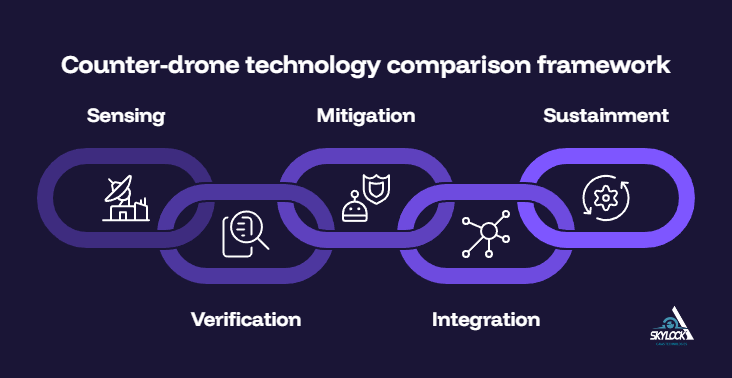
Counter-Drone Detection Technologies Compared: RF, Radar, EO/IR, Acoustic, and LiDAR
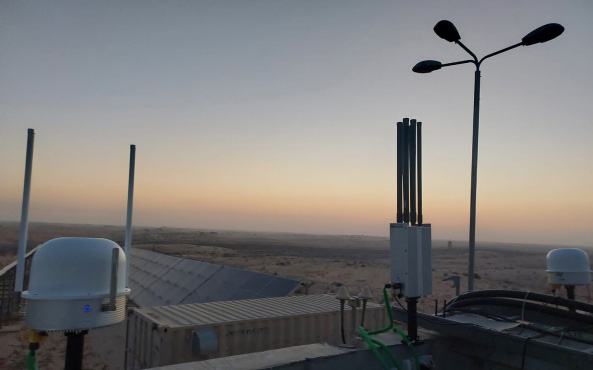
Detection technologies should be compared by the type of awareness they create. No single sensor performs equally well in every environment, so each layer should be assessed by its role, limits, and integration value.
| Technology | Best for | Key limitation | Integration requirement |
| RF detection | Passive early warning and, when the drone or controller is emitting and direction-finding or triangulation conditions support it, potential controller-location insight. | Depends on drone emissions. Autonomous, encrypted, pre-programmed, or RF-silent drones can reduce effectiveness | Correlate with radar or EO/IR to turn signal intelligence into a track and verified event |
| Radar | Persistent tracking, wide-area awareness, and detection of RF-silent drones | Small radar cross-section targets, clutter, low-altitude flight, terrain masking, birds, buildings, and sea conditions can affect performance | Cue EO/IR and feed C2/C4I so operators can move from track detection to identification |
| EO/IR | Visual verification, classification support, evidence capture, and incident documentation. | Requires line of sight and is affected by weather, visibility, field of view, and operator workload | Use automated slew-to-cue from radar or RF, plus evidence logging |
| Acoustic detection | Close-range gap-filling, especially where terrain or RF silence limits other sensors | Sensitive to wind, traffic, machinery, ambient noise, and range | Feed confidence scoring into the wider sensor picture |
| LiDAR | Precise line-of-sight measurement in defined zones | Limited by weather, obscurants, range, and field of view | Use as a specialist layer, not a primary wide-area detection method |
The strongest detection posture comes from multi-sensor correlation. RF may provide early signal awareness, radar may maintain the track, and EO/IR may verify the target. Acoustic and LiDAR can fill specific gaps. The operational value comes when these inputs are fused into one prioritised picture that reduces false alarms and gives operators enough confidence to act. This is also where track continuity matters: operators need a stable airspace picture that connects the first alert to tracking, verification, and authorised response without forcing teams to rebuild context mid-incident.
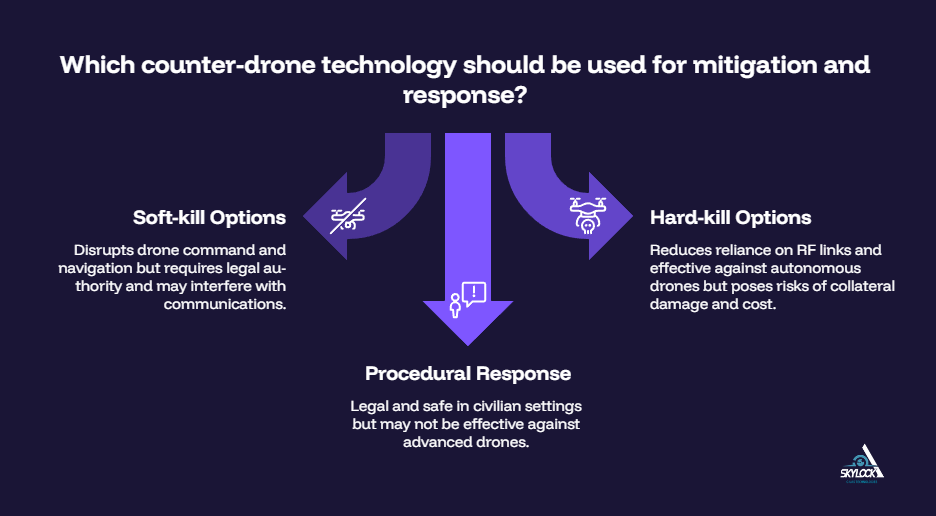
Counter-Drone Mitigation Technologies: What Is Authorised, Suitable, and Safe?
Mitigation should not be evaluated only by whether it can stop a drone. It should be evaluated by whether it is authorised, proportionate, safe for the site, and suitable for the target profile.
1. Soft-kill options include:
- RF jamming
- GNSS interference
- Spoofing
- Protocol-level effects where supported
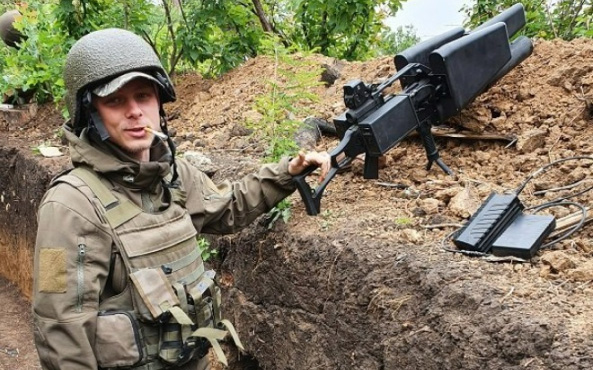
These methods may disrupt command links, navigation, or control behaviour in some scenarios, but they depend on the drone’s communications, guidance architecture, anti-spoofing resilience, and the local spectrum environment.
They also require explicit legal authority and careful operational safeguards. In the U.S., interagency guidance on counter-UAS detection and mitigation explains that activities involving jamming, spoofing, unauthorised system access, seizure, or disablement may implicate federal communications, computer misuse, aviation, and spectrum laws. Equipment compliance does not itself authorise deployment, and mitigation can interfere with communications, navigation systems, or other legitimate spectrum users.
2. Hard-kill options include:
- Nets
- Interceptor drones
- Kinetic systems
- Directed energy
These approaches can reduce reliance on RF links and may be relevant against autonomous or RF-silent drones. They also introduce different risks: collateral damage, falling debris, engagement geometry, cost per engagement, line of sight, power requirements, and safety around people, aircraft, vessels, or critical equipment.
3. Procedural response
This is often the only authorised option in civilian or regulated environments. This can include:
- Notifying law enforcement
- Activating ground security
- Coordinating with aviation authorities
- Changing runway procedures, locking down sensitive areas
- Protecting the target asset until the drone leaves the area
The key question is not “which countermeasure is strongest?” It is “which response can be used legally, safely, and consistently in this mission environment?” A serious counter-UAS architecture should map every response option against legal authority, ROE, site safety constraints, collateral risk, evidence requirements, and operational disruption before deployment.
Why C2/C4I Integration Determines Counter-UAS Effectiveness
Raw detection is not an operational defence. A sensor can flag a possible drone, but operators still need to know what it is, where it is moving, how confident the alert is, and which response is authorised.
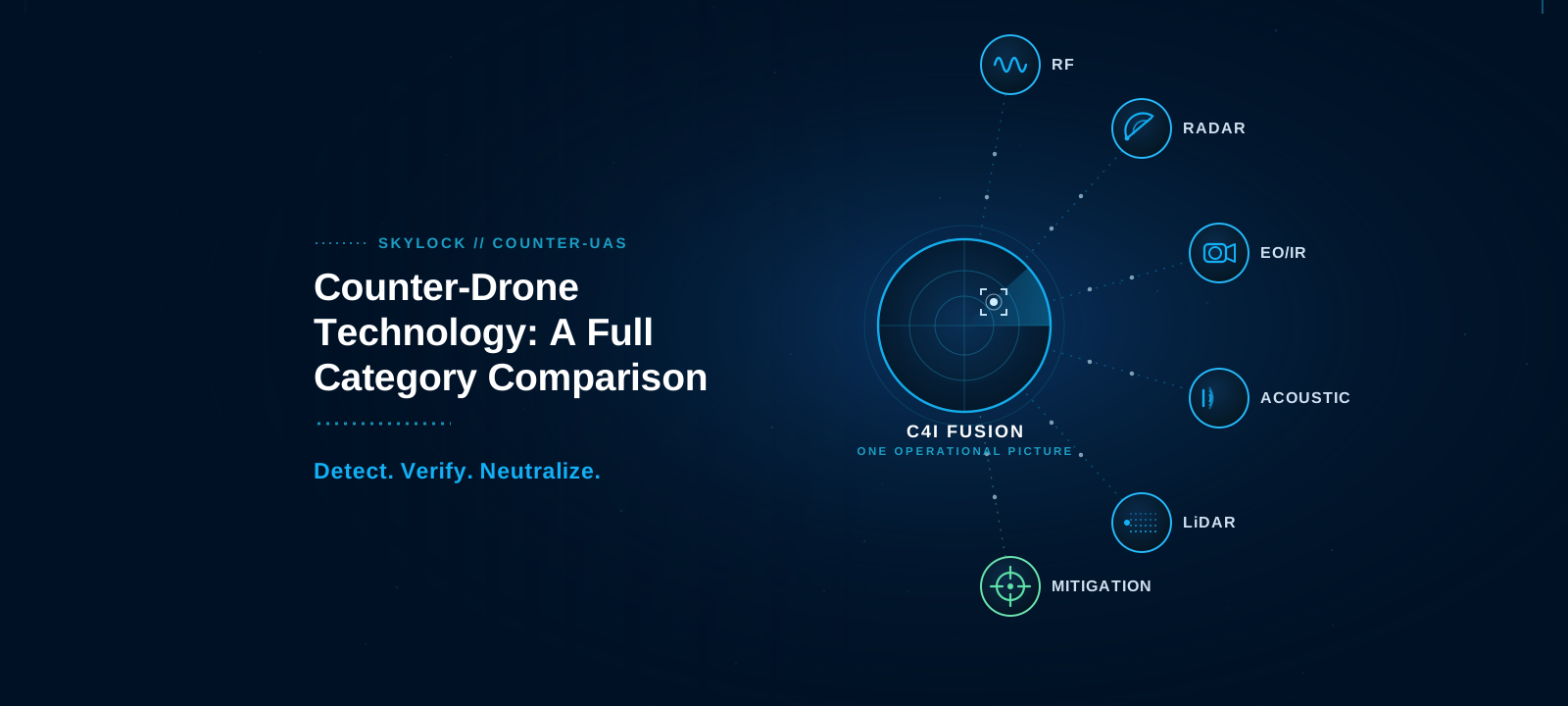
C2/C4I turns separate sensor feeds into one operational picture. It fuses radar, RF, EO/IR, acoustic, and other inputs into a shared track view, prioritises threats, filters nuisance alarms, and cues EO/IR for visual verification.
This layer also connects counter-UAS events to existing SOC, VMS, PSIM, ISR, or national command environments, reducing handovers and keeping drone incidents inside the main response workflow. Track data, visual evidence, operator actions, and response decisions should be logged for review and accountability. This same discipline should extend to cyber and system-risk handling, where validated findings need to move through a clear operational response workflow so teams can assign ownership, track progress, and close issues without creating new gaps.
SKYLOCK fits here as a field-proven, multi-layer Counter-UAS platform with open-architecture C4I integration, supporting verified identification, prioritised response, and documented action in one operator-light workflow.
How to Choose Counter-Drone Technology by Mission Environment
Counter-drone technology performs differently across mission environments. The right architecture depends on the site, mobility requirements, operating conditions, and response constraints.
| Mission environment | What the architecture should prioritise |
| Fixed sites | Persistent coverage, reliable power and communications, redundancy, evidence logging, long-term sustainment, and integration with existing security operations |
| Mobile and tactical units | Rapid deployment, low operator burden, compact design, resilient communications, and awareness on the move or during temporary operations |
| Airports | Careful verification, low nuisance-alarm rates, coordination with aviation stakeholders, and response options that do not create new safety risks |
| Maritime and port environments | Sea-clutter handling, hardened equipment, corrosion resistance, and workflows that account for mixed air, surface, and infrastructure activity |
| Borders | Distributed coverage, terrain-masking mitigation, communications resilience, mobility, and the ability to shift coverage as threat patterns change |
For fixed sites, counter-UAS should be planned as one layer of the wider site-security architecture, alongside physical perimeter protection, access control, surveillance, and incident response workflows. The right deployment model is not the one with the strongest individual sensor claim. It is the one that matches the mission environment, integrates into the command workflow, and can be operated consistently over time.
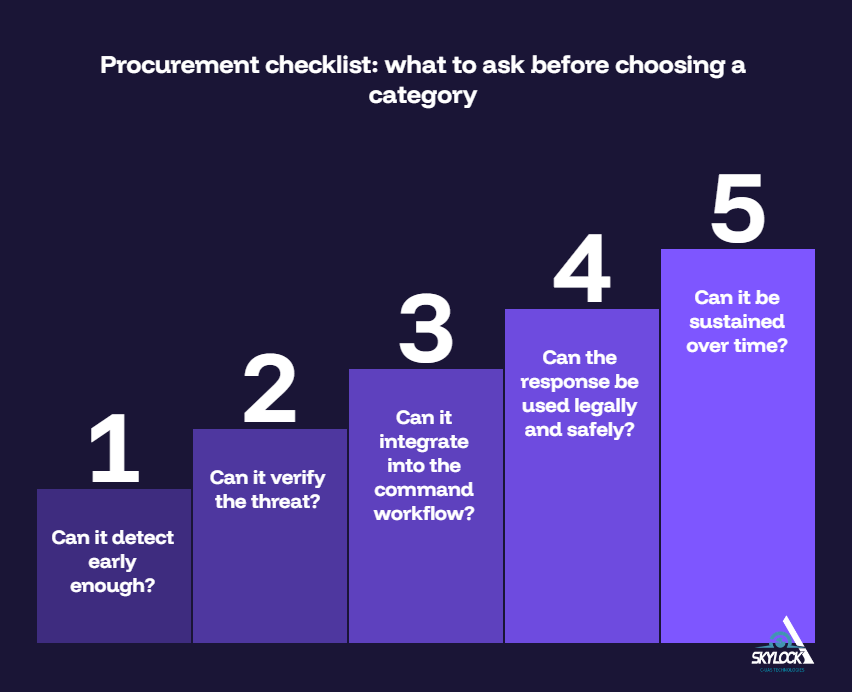
Counter-Drone Technology Procurement Checklist
Procurement teams should evaluate counter-drone technology based on how it performs inside the mission workflow, not by category labels or headline specifications. When RF is part of the stack, assess it as an early-warning layer by asking what it can confirm, where silent flight or spectrum congestion may limit coverage, and how reliably it cues radar or EO/IR for verification.
Use this sequence to test operational fit.
1. Can it detect early enough?
- Does it provide enough warning before the drone reaches the protected asset?
- Can it maintain a stable track in the actual site environment?
- Does it reduce false alarms, or will it add more alerts for operators to sort?
2. Can it verify the threat?
- How is a drone confirmed before escalation?
- Does the system cue EO/IR automatically for visual verification?
- Is evidence logged for review, reporting, and legal defensibility?
3. Can it integrate into the command workflow?
- Does it connect to existing C2/C4I, SOC, VMS, PSIM, ISR, or national command environments?
- Will operators work from one shared picture, or separate sensor screens?
- What custom integration work is required before the system is operationally useful?
4. Can the response be used legally and safely?
- Which mitigation options are available where authorised?
- What ROE, legal authority, or site-specific safety constraints apply?
- Can the system still deliver value when neutralisation is restricted or unavailable?
5. Can it be sustained over time?
- What training, spare parts, software updates, and cybersecurity support are included?
- What SLAs support uptime and mission readiness?
- Can the architecture adapt as drone threats, regulations, and mission requirements change?
The best category is the one that fits the mission, integrates into the command workflow, and can be operated consistently under pressure. For programmes with cyber exposure or C4I integration requirements, structured risk assessment training can also help security, IT, and compliance teams evaluate system risks consistently and support better sustainment decisions over time.
No Single Counter-Drone Technology Secures Low-Altitude Airspace Alone
The right counter-UAS posture is not built by choosing one technology category. It is built by matching sensors, verification tools, response options, integration, and sustainment to the mission environment.
RF detection, radar, EO/IR, acoustic sensing, LiDAR, jamming, spoofing, interceptors, and hard-kill options all have a role, but none operate in isolation. Each depends on site conditions, target behaviour, operator workload, legal authority, and the command workflow around them..
SKYLOCK supports this approach as a field-proven, multi-layer Counter-UAS platform built around detection, verified identification, neutralisation where authorised, and open-architecture C4I integration. To evaluate which mix of counter-drone technologies fits your environment, talk to a SKYLOCK defence expert or request a site-specific drone threat and coverage assessment.