Top Drone Jammers by Category: 16 Counter-UAS Solutions to Evaluate in 2026
 The Skylock Team
Abstract
- Drone jammers are electronic countermeasure systems that disrupt the control, telemetry, video, or satellite-navigation links used by unauthorised drones.
- They are one possible response layer inside a Counter-UAS architecture, not a strategy on their own.
- This guide compares 16 professional drone jammers, mitigation tools, and Counter-UAS solutions across five mission categories: integrated Counter-UAS architectures, portable and dismounted systems, vehicle-mounted and on-the-move systems, fixed-site RF inhibition and sensitive-environment alternatives
- Each option is evaluated against mission, threat, operating environment, legal and ROE constraints, C2/C4I integration, verification workflow, operator burden, and required outcome.
- The key takeaway: the right drone jammer starts with the mission, and the strongest capability is the architecture that connects detection, verification, and authorised response into one operational workflow.
Small drones can compress the time between detection and impact to minutes or even seconds. For security teams, simply spotting a drone is not enough. Operators must detect it, verify the threat, determine an authorised response and act before the aircraft reaches the protected area.
Research shows just how narrow that window can be. A recent study found that trained observers detected three classes of small commercial drones at average visual ranges of only 176 to 451 metres. The researchers also found that a drone travelling faster than 20 m/s could reach its target before a human chain-of-command response was completed.
This compressed response window is one reason drone jammers and other Counter-UAS mitigation technologies have become an important layer of modern airspace security. However, solutions differ significantly in how they detect, verify and neutralise drones, how they integrate with existing command environments, and where their use is legally authorised. This guide compares leading drone jammers and Counter-UAS solutions by deployment model, mitigation approach and operational fit.
Start with the mission, not the jammer
Organisations evaluating drone jammers usually already understand the threat. The harder question is what capability they are trying to build. A drone jammer should not be assessed as a standalone device. It should be evaluated as one possible layer inside a Counter-UAS architecture shaped by mission, threat, environment, legal constraints, operational concept, and only then technology.
A jammer cannot be assessed in isolation from the workflow that tells the operator what has entered the airspace, whether it is actually a drone, where it is going, what response is authorised, and how that response fits the mission.
For serious security environments, selection therefore needs to start with the mission and then account for the threat, operating environment, deployment model, detection and verification workflow, C2/C4I integration, operator workload, spectrum constraints, site-specific safety requirements, sustainment, and legal authority.
A better Counter-UAS architecture starts with the right questions
Counter-UAS procurement often starts in the wrong place. The first question should not be which jammer has the longest range. It should be what mission must be protected.
The first question should not be which technology is strongest. It should be against what threat, in what environment, and under what constraints.
The first question should not be what the system can defeat. It should be what outcome is authorised, proportionate, safe, and operationally useful.
A better design cascade starts with the mission, then defines the threat, environment, legal and ROE constraints, operational concept, and only then the technology configuration. Technology is chosen last because every layer has both value and limitations. The procurement goal is not to buy the strongest individual technology. It is to build the right Counter-UAS formula for the mission.
Top picks by category
| Category | Top pick | Why it fits |
| Integrated Counter-UAS platform with drone jamming capability | Skylock Multi-Layer Counter-UAS Platform | Designed to turn mission requirements into a multi-layer Counter-UAS architecture, integrating detection, verification, C4I, and authorised response rather than adding another isolated technology layer |
| Portable and dismounted drone jammer | DroneShield DroneGun Mk4 / Immediate Response Kit | Combines portable RF detection and directional defeat for authorised tactical teams requiring rapid deployment |
| Vehicle-mounted and on-the-move | AeroVironment Titan 4 RF C-UAS | RF detect-and-defeat architecture designed for mobile as well as dismounted and fixed deployment |
| Fixed-site RF inhibition | Allen-Vanguard ANCILE | Purpose-built RF inhibition approach for persistent protection of authorised fixed sites |
| Sensitive-environment alternative | D-Fend Solutions EnforceAir PLUS / EnforceAir2 | Provides RF cyber takeover as an alternative to broad jamming, while EnforceAir PLUS adds radar and optional smart RF-effector jamming |
There is no useful “best overall” designation here. A dismounted jammer, an airport detection workflow, a convoy protection system, and an integrated base-protection architecture solve materially different mission problems. The right architecture depends on the mission, threat, environment, authority, operational concept, and acceptable level of risk.
Integrated Counter-UAS architecture
Integrated Counter-UAS architectures are suited to military bases, government sites, borders, ports, critical infrastructure, major events, and other environments where detection, verification, command-and-control, and authorised response must operate as one workflow.
The differentiator is orchestration. Rather than asking an operator to detect a drone in one system and independently activate another, the architecture brings multiple sensor inputs together through a data pipeline, supports verification, and presents authorised response options through a common operating picture.
| Solution | Primary fit | Sensing/C2 role | Mitigation | Integration posture | Key consideration |
| Skylock Multi-Layer Counter-UAS Platform | Programme-level Counter-UAS | Multi-sensor C4I | Configuration-dependent authorised mitigation, including jamming | Open architecture | Designed around detect, verify, neutralise |
| Rafael Drone Dome | Defence and high-value sites | Multi-sensor C2 | Multi-effector | Open, modular architecture | Broad end-to-end C-UAS architecture |
| Leonardo Falcon Shield | Defence, bases, critical sites | Integrated sensor and threat management | Soft and hard countermeasures | Modular and scalable | Strong operational and sustainment evidence |
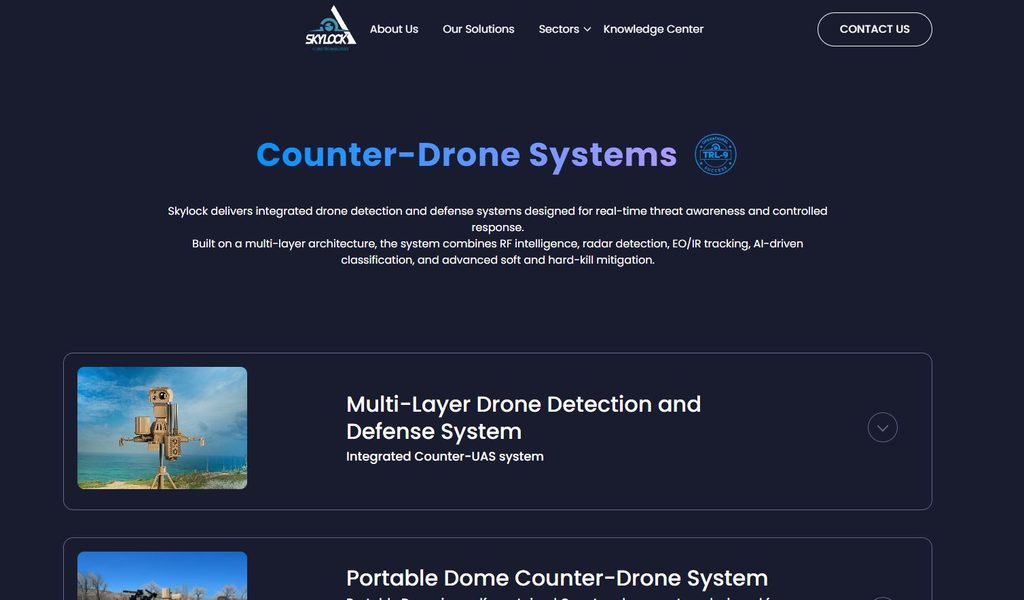
1. Skylock Multi-Layer Counter-UAS Platform
Best for: Organisations that need to build a mission-specific Counter-UAS capability, not add another disconnected sensor or jammer.
Why it fits: Skylock’s value is not another isolated technology layer. It is the ability to create the right Counter-UAS formula for the mission. Its C4I architecture integrates sensing, verification, and authorised response into a unified operational picture, supporting faster verified identification, lower operator burden, and more consistent decision-making across fixed-site, mobile, and tactical deployment models.
Key capabilities: Mission-specific Counter-UAS architecture, multi-layer sensing, open-architecture C4I integration, verification workflows, sensor-to-effector coordination, operator-light workflows, and support for fixed-site, mobile, and tactical deployment models depending on configuration.
Strengths and considerations: The procurement advantage is architectural fit. Buyers can define the mission first, then configure the sensor, verification, C4I, and response layers around the operational environment rather than assuming every deployment requires the same radar, RF, EO/IR, acoustic, AI-assisted, or mitigation configuration.
Actual detection and mitigation performance remains configuration- and site-dependent, including terrain, clutter, spectrum conditions, target profile, and applicable legal or ROE restrictions.
Pricing and availability: Not publicly disclosed.
Secondary fit: Critical infrastructure, airport airspace protection where legally permitted, border security, maritime operations, force protection, and major events.
Skylock’s C4I layer turns fragmented sensor inputs into a unified operational picture, helping operators move from detection to verification and authorised response with fewer manual handoffs.

2. Rafael Drone Dome
Best for: Defence and government buyers seeking a modular, multi-sensor, multi-effector Counter-UAS architecture.
Rafael describes Drone Dome as an end-to-end system covering detection, identification, classification, neutralisation, and interception. Its C2 layer correlates inputs from sensors, effectors, and external systems into a common air situational picture.
Its main procurement strength is architectural breadth rather than a single jamming device. Buyers should assess which sensors and effectors are included in the proposed configuration, interoperability with existing command systems, and the sustainment model.
Pricing: Not publicly disclosed.
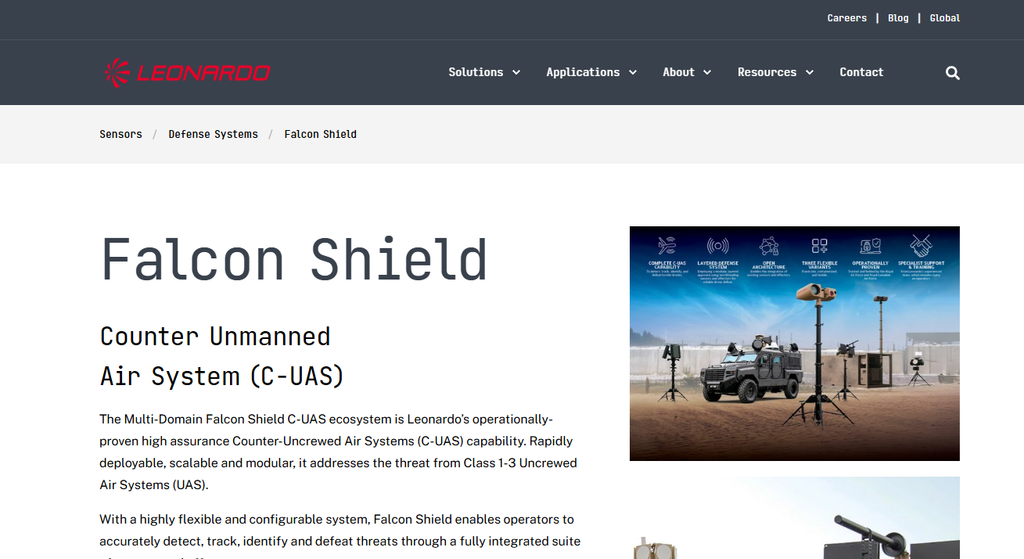
3. Leonardo Falcon Shield
Best for: Defence programmes requiring a scalable Counter-UAS system with documented operational use and long-term support.
Falcon Shield combines sensors and threat-management effectors for detecting, tracking, identifying, geolocating, and mitigating UAS. Leonardo’s current material describes fixed, mobile/on-the-move, naval, and man-portable configurations.
Leonardo also has substantial public operational evidence. Canada selected Falcon Shield with a ten-year sustainment package, while the technology has previously been used by the UK Armed Forces and deployed in support of major events and airport incidents.
Pricing: Not publicly disclosed.
Portable and dismounted drone jammers
Portable systems prioritise mobility, rapid deployment, and manageable operator burden. They suit dismounted forces, patrols, authorised law-enforcement teams, and rapid-response units. But portability alone does not create capability. The operational question is how the operator receives warning, verifies the target, coordinates with the wider force, and acts within legal authority and ROE.
The procurement question is not only whether the jammer is portable. Buyers should establish how the operator receives initial threat information, verifies the target, receives targeting data, and coordinates mitigation with the wider force.
| Solution | Form factor | Mitigation | Detection dependency | Ideal user | Key consideration |
| DroneShield DroneGun Mk4 / IRK | Handheld / kit | RF/GNSS disruption | IRK includes RfPatrol Mk2 | Tactical teams | Integrated portable detect-and-defeat option |
| DedroneDefender 2 | Handheld | RF/GNSS smart jamming | Can integrate with DedroneTracker.AI | Military/public safety | Networked targeting and mitigation |
| TRD ORION-H10 / ORION family | Handheld/manpack | Electronic mitigation | Configuration-dependent | Tactical teams | Verify current configuration during procurement |
4. DroneShield DroneGun Mk4 / Immediate Response Kit
Best for: Authorised teams needing rapidly deployable detection and defeat.
DroneShield’s Immediate Response Kit combines its passive RfPatrol Mk2 detector with the DroneGun Mk4. The company lists wide ISM-band and GNSS disruption capability for DroneGun Mk4 and positions the kit for immediate field deployment.
The combined kit is more relevant to many procurement teams than assessing the jammer alone because it addresses the alert-to-response chain.
Pricing: Not publicly disclosed.
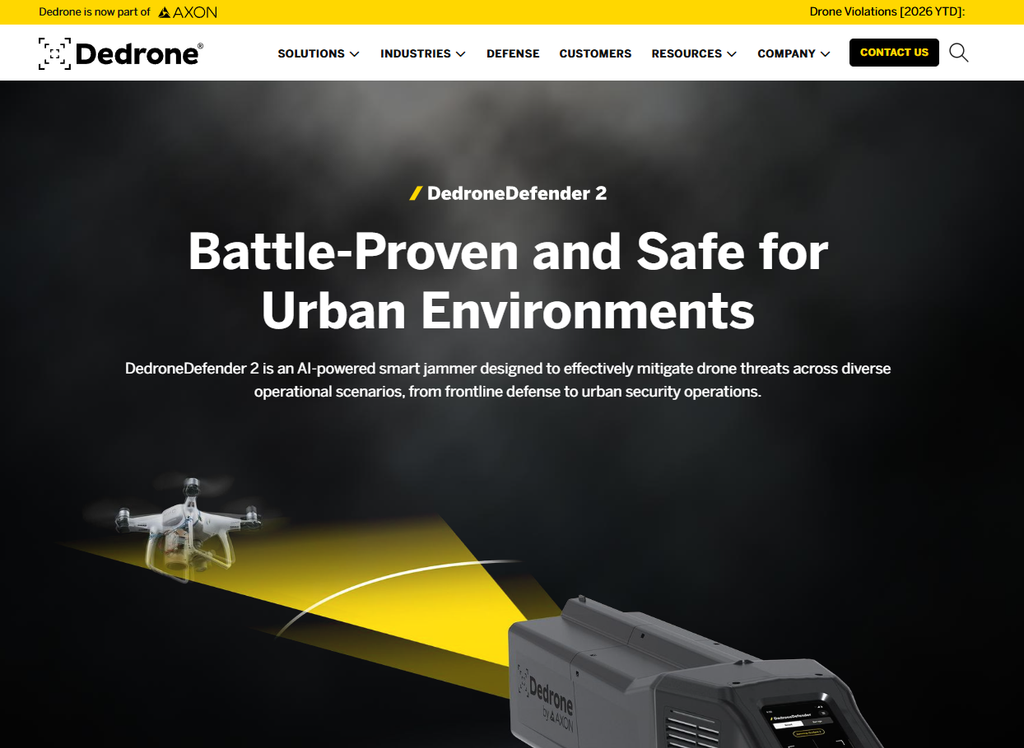
5. DedroneDefender 2
Best for: Teams requiring a handheld jammer connected to a wider C2 and detection environment.
DedroneDefender 2 supports RF and GNSS jamming and can receive targeting information from DedroneTracker.AI. Dedrone positions the system for precision targeting, including situations where the target is beyond unaided visual identification range.
That integration is the important distinction. A handheld effector becomes considerably more useful when operators receive verified track and targeting information rather than searching for the drone independently.
Pricing: Not publicly disclosed.

6. SteelRock NightFighter X
Best for: Dismounted teams seeking a handheld directional jammer with optional command-and-control connectivity.
NightFighter X combines its electronics and battery in a single handheld unit. SteelRock lists seven RF and GPS bands and an optional C2 plug-in for networking the device into a wider operational environment.
For procurement teams, the main consideration is how the operator receives and verifies threat information before using the jammer. Buyers should assess the proposed detection and cueing arrangements, what the optional C2 connection supports, and whether the unit’s 6.2 kg weight with battery suits the intended patrol or response role.
Pricing: Available on request.
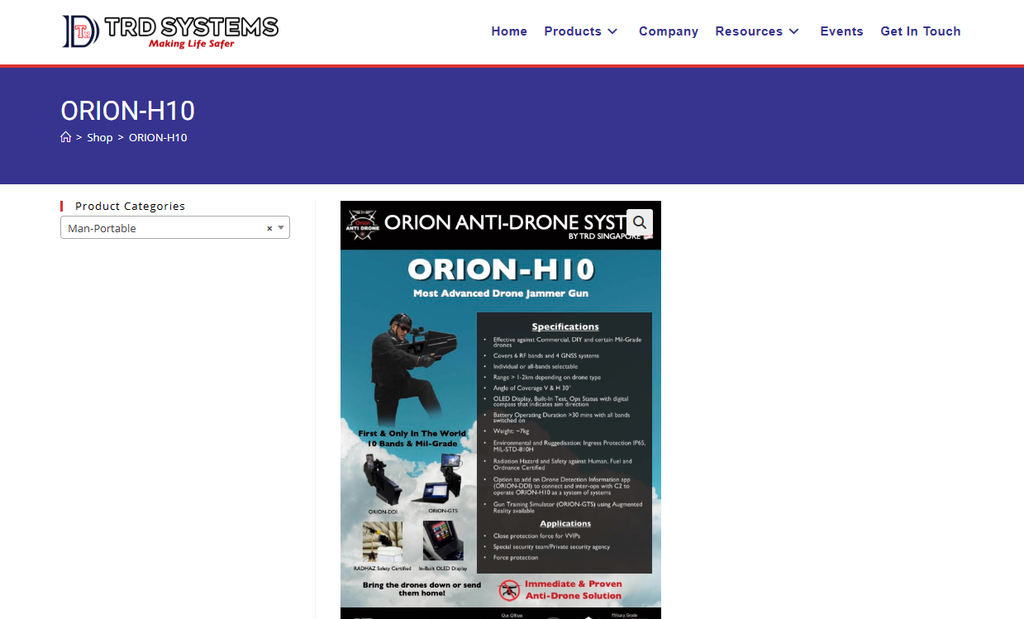
7. TRD ORION-H10 / ORION family
Best for: Buyers comparing handheld and manpack electronic counter-drone options.
The ORION family belongs in the tactical evaluation set because of its handheld/manpack positioning. Procurement teams should, however, validate the exact current model, frequency configuration, integration interfaces, support status, and mitigation capabilities directly during RFI/RFP.
Pricing: Not publicly disclosed.
Vehicle-mounted and on-the-move Counter-UAS systems
Mobile Counter-UAS introduces requirements that fixed installations do not. The architecture must preserve airspace awareness, cueing, verification, C2 connectivity, and authorised response while the protected asset is moving.
| Solution | Platform fit | Mitigation | On-the-move capability | C2 integration | Key consideration |
| AeroVironment Titan 4 | Vehicle, dismounted, fixed | RF detect-and-defeat | Supported | Designed for interoperability | Flexible deployment |
| DroneShield DroneSentry-X Mk2 | Vehicle / expeditionary | Electronic defeat | Yes | DroneShield ecosystem | Mobile, modular architecture |
| MARSS NiDAR X-SCOUT | Vehicle-delivered expeditionary | RF/GPS jamming | Rapidly deployed remote node | NiDAR C2 | Distributed mobile coverage |
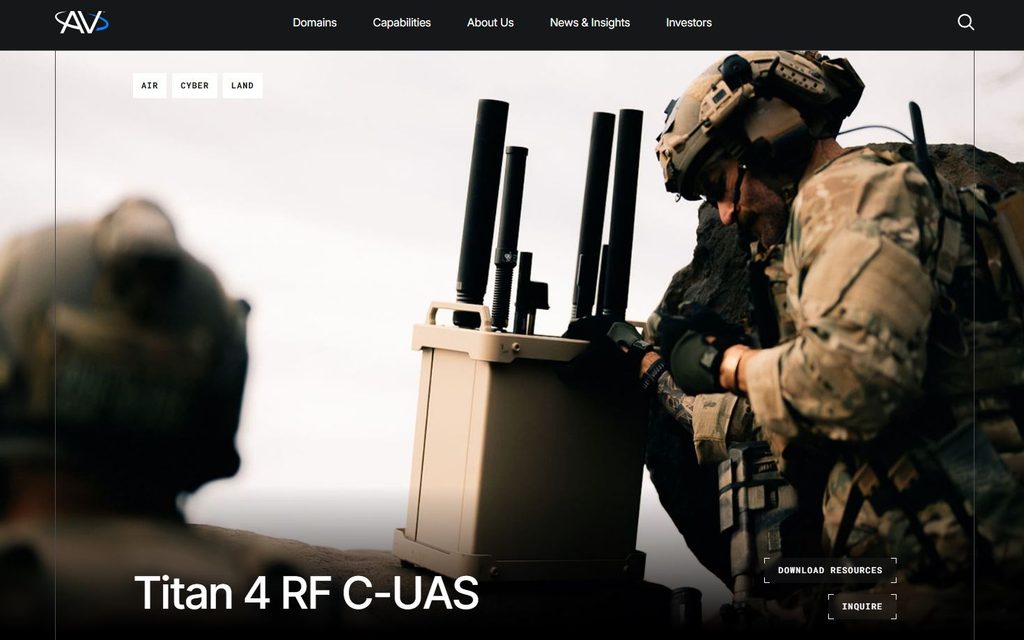
8. AeroVironment Titan 4 RF C-UAS
Best for: Convoy, mobile-force, and expeditionary protection requiring RF detection and defeat.
Introduced in 2025, Titan 4 is an RF-based system designed to detect and defeat Group 1 and Group 2 drone threats. AeroVironment positions it for mobile, dismounted, and fixed-site use, with rapid deployment and extensible integration.
The procurement case is therefore deployment flexibility. Buyers should examine how the proposed installation integrates with vehicle power, communications, existing C2, and the rest of the convoy’s protection architecture.
Pricing: Not publicly disclosed.
9. DroneShield DroneSentry-X Mk2
Best for: Vehicle-mounted and rapidly deployable electronic protection.
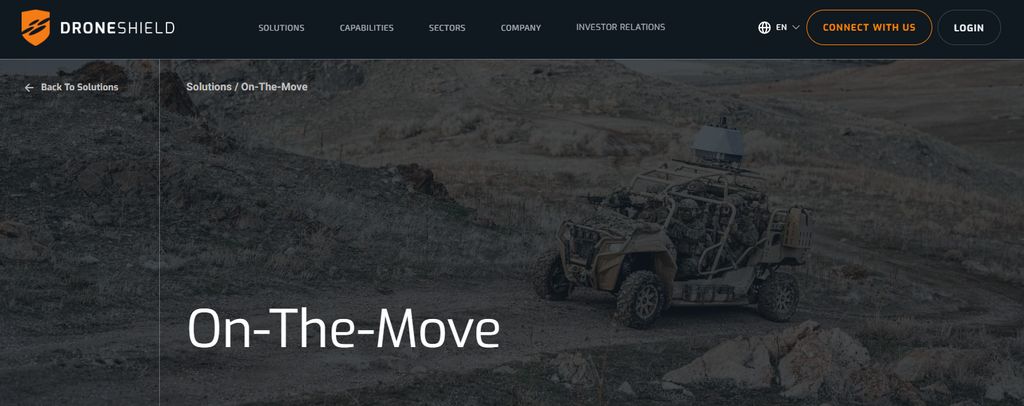
DroneShield positions DroneSentry-X Mk2 specifically within its on-the-move portfolio. The platform combines detection, identification, and electronic defeat and can also be configured through an expeditionary fixed-site kit.
That flexibility is useful for forces moving between convoy protection and temporary operating locations without procuring completely separate architectures.
Pricing: Not publicly disclosed.
10. MARSS NiDAR X-SCOUT
Best for: Expeditionary forces needing rapidly positioned remote Counter-UAS nodes.
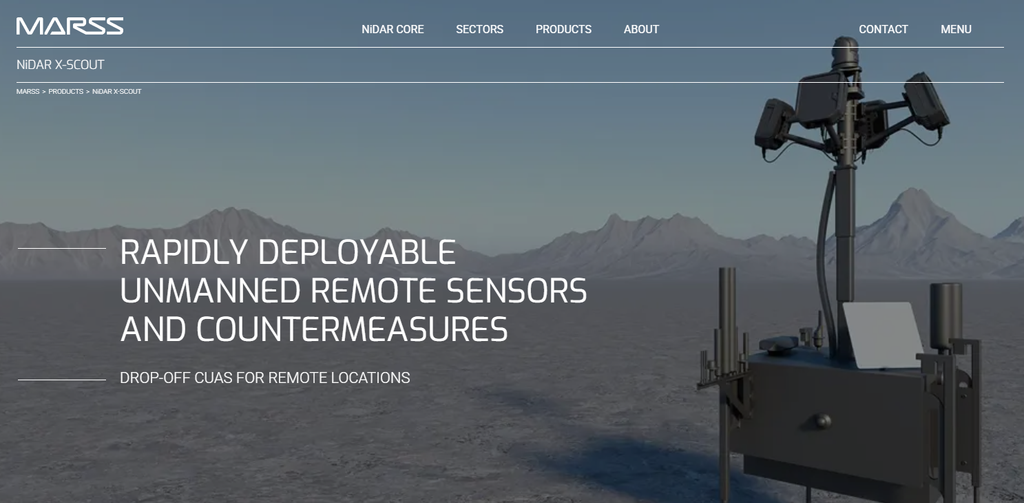
X-SCOUT is a vehicle-delivered remote sensor and countermeasure system that MARSS says can become operational in under five minutes. Multiple units can operate as a mesh connected to the NiDAR environment, with RF and GPS jamming countermeasures available.
This makes it particularly relevant where the requirement is not simply “jam from a vehicle”, but extend the protected area by rapidly placing connected nodes around a changing operational footprint.
Pricing: Not publicly disclosed.
Dedicated RF inhibition as one response layer
Dedicated RF inhibition systems are built around electronic mitigation rather than a full detect, verify, decide, and respond workflow. Depending on the configuration, they can support vehicle-mounted, quick-deploy, base, and facility protection requirements, but they should be evaluated as one response layer inside a wider Counter-UAS concept.
For procurement teams, the key questions are how the inhibition capability integrates with existing detection and command systems, what deployment models are supported, and how spectrum, legal authority, maintenance, and lifecycle support will be managed.
| Solution | Protected environment | Coverage model | Integration | Mitigation | Key consideration |
| Allen-Vanguard ANCILE | Convoy, base, and facility protection | Vehicle-mounted, quick-deploy, and site protection | Configuration-dependent | RF inhibition | Dedicated inhibition capability across multiple deployment models |
| HENSOLDT / ESG GUARDION | Military/civil protected sites | Modular multi-sensor | C2 and infrastructure integration | Multiple countermeasures | Integrated rather than jammer-only |
| DroneShield DroneSentry | Critical sites/public safety | Modular fixed site | Sensor/C2 ecosystem | Configuration-dependent | Scalable multi-sensor protection |
11. Allen-Vanguard ANCILE
Best for: Authorised facilities evaluating dedicated RF inhibition against commercial drone threats.
ANCILE represents a dedicated RF-inhibition approach that can support vehicle-mounted, quick-deploy, base, and facility protection. For buyers, the critical questions are coverage geometry, spectrum coordination, integration with existing detection and verification systems, and how the capability will be maintained over its service life.
Those considerations matter because an RF-inhibition system cannot be evaluated solely by nominal RF output. Its operational suitability depends on the deployment environment, communications conditions, and applicable legal authority.
Pricing: Not publicly disclosed.
12. HENSOLDT / ESG GUARDION
Best for: Fixed sites requiring modular detection, C2, and countermeasure integration.
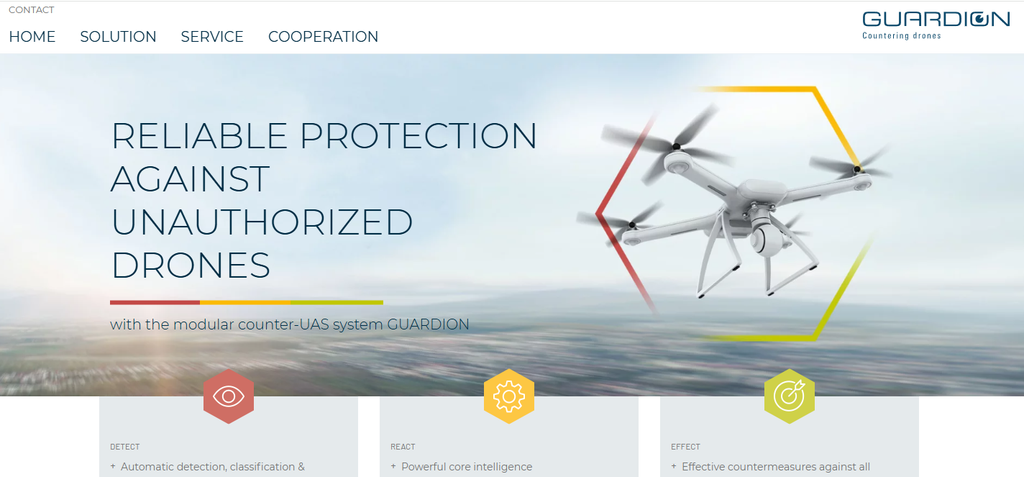
GUARDION combines automatic detection and classification with multi-sensor processing, an integrated command-and-control environment, and countermeasures. HENSOLDT positions it across environments ranging from airports to military camps.
This makes GUARDION more comparable with an integrated site-defence architecture than with a standalone jammer.
Pricing: Not publicly disclosed.
13. DroneShield DroneSentry
Best for: Facilities seeking configurable, persistent Counter-UAS protection.
DroneSentry sits within DroneShield’s fixed-site portfolio and combines multiple sensor technologies and C2 capabilities. DroneShield positions the platform for infrastructure, correctional facilities, and other high-risk locations requiring persistent airspace awareness and defence.
Procurement teams should establish the exact sensors and mitigation elements included in a proposed configuration rather than assuming every DroneSentry deployment is identical.
Pricing: Not publicly disclosed.
Sensitive-environment alternatives to broad-spectrum jamming
Broad RF or GNSS disruption is not appropriate for every mission. Airports, dense urban areas, major events, VIP movements, and communications-sensitive infrastructure can require response methods designed to reduce collateral effects and align tightly with legal authority, spectrum rules, ROE, and operational regulations.
Alternatives include protocol or RF-cyber takeover and physical interception. These approaches have their own target-compatibility, safety, and regulatory limitations, so “non-jamming” should not be interpreted as universally deployable.
| Solution | Method | Difference from broad jamming | Best-fit environment | Main constraint |
| D-Fend EnforceAir PLUS / EnforceAir2 | RF cyber takeover; optional jamming in PLUS | Can take control of supported drones | Sensitive/complex sites | Target/protocol compatibility |
| Sentrycs Fixed / Portable Kit | Protocol manipulation | Detects and can take control of supported drones | Urban/static/ad-hoc protection | Supported-drone matrix |
| Fortem DroneHunter | Kinetic net interception | Physical capture rather than RF disruption | Sites prioritising low RF impact | Engagement geometry and physical safety |
14. D-Fend Solutions EnforceAir PLUS / EnforceAir2
Best for: Buyers requiring controlled mitigation options in communications-sensitive environments.
EnforceAir uses RF-cyber technology to detect, identify, and take control of supported rogue drones. EnforceAir PLUS extends that model with integrated radar and an optional smart RF-effector jamming layer.
This gives procurement teams an escalation path rather than forcing a choice between cyber takeover and conventional jamming at architecture level.
The main consideration is compatibility. Protocol-based mitigation depends on the target technology and operating conditions, so buyers need a clear understanding of the supported threat set.
Pricing: Not publicly disclosed.

15. Sentrycs Fixed Kit / Portable Kit
Best for: Static or rapidly deployed sites seeking protocol-based detection and controlled mitigation.
Sentrycs uses protocol manipulation, also described by the company as Cyber over RF. Its system can detect, track, and identify supported drones and, when the optional mitigation module is enabled, take control and direct them towards predefined outcomes.
The technology can also integrate with radar, EO, and jammer layers, making it relevant as one component of a broader Counter-UAS architecture.
Pricing: Not publicly disclosed.
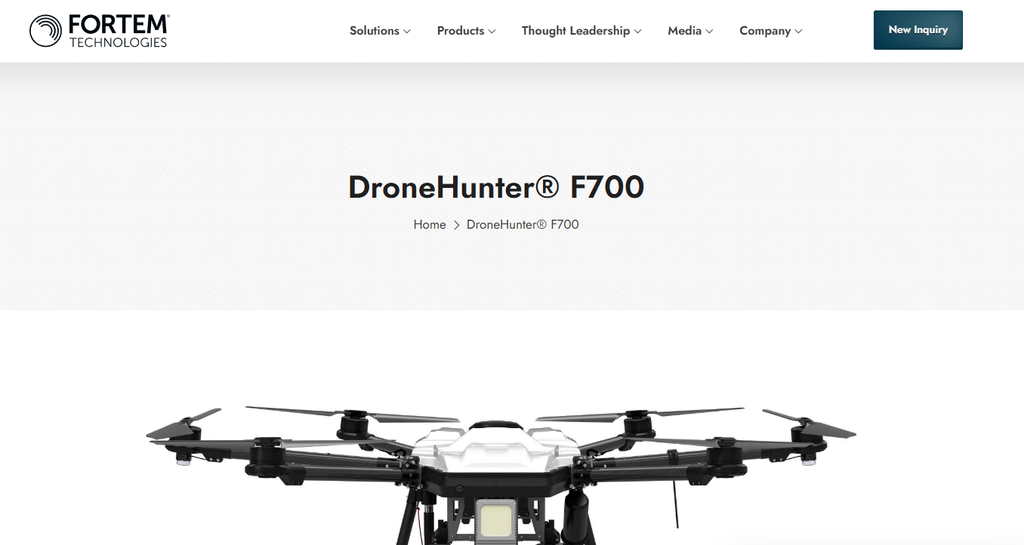
16. Fortem DroneHunter
Best for: Environments where RF disruption is undesirable and physical interception is operationally acceptable.
Fortem’s DroneHunter uses airborne interceptors and nets rather than RF jamming to defeat targets. In February 2026, Fortem reported a live five-versus-five autonomous intercept test in which five DroneHunter F700 aircraft captured five incoming drones under a single SkyDome system.
Net interception removes some spectrum concerns associated with electronic attack, but introduces different considerations: interception geometry, falling objects, launch and recovery requirements, airspace coordination, and physical safety.
Pricing: Not publicly disclosed.
How we compared these Counter-UAS options
This comparison was researched in September 2026 using publicly available vendor information, product documentation, regulatory guidance, and public programme information. It does not represent hands-on testing, independent performance validation, or operator interviews.
Solutions were included where they had a documented professional Counter-UAS role, identifiable mitigation capability, a clear deployment model, and relevance to defence, government, critical infrastructure, border, maritime, airport, or major-event procurement.
Across categories, the comparison followed a mission-first logic: mission, threat, environment, legal and ROE constraints, operational concept, technology configuration, C2/C4I integration, operator burden, verification workflow, authorised response options, and available sustainment evidence.
Public specifications remain uneven. Range, supported targets, frequency coverage, API maturity, pricing, and customer configurations are not consistently disclosed. More importantly, performance depends on configuration, terrain, clutter, line of sight, antenna placement, spectrum conditions, target characteristics, firmware, weather, and operating restrictions.
A brochure range should therefore never substitute for a site-specific assessment.
How to design the right Counter-UAS architecture
Start with the mission.
An airport, a forward operating base, a convoy, a port, and a major event may face similar drone types, but they do not share the same operating constraints. Dismounted units need low weight, rapid operation, and a reliable way to receive and verify threat information. Convoys need vehicle integration, on-the-move coverage, power, networking, and C2 connectivity. Fixed facilities need persistent coverage, SOC/C4I integration, audit trails, maintainability, and predictable support.
Next, define the verification workflow. A mitigation system is operationally weak if the operator cannot establish which target to engage. Radar, RF, and EO/IR each contribute different information, and multi-layer correlation can reduce false alarms and shorten the path from detection to verified identification.
Then define authority before capability. A system’s technical ability to jam, spoof, take over, or intercept a drone does not mean the operator is legally authorised to do so. Legal authority, ROE, spectrum rules, aviation safety, site-specific safety constraints, and operational regulations must shape the response layer before the technology is selected.
Finally, evaluate the programme rather than only the product. Integration, software updates, training, spare parts, maintenance, cybersecurity, operator oversight, acceptance testing, and future sensor or effector upgrades determine whether today’s architecture remains mission-ready years after deployment.
Skylock: Turning Counter-UAS technologies into operational advantage
Skylock is designed for organisations that need more than another isolated sensor, jammer, or software console. Its approach brings mission definition, sensing, verification, command-and-control, and authorised response into a multi-layer Counter-UAS architecture. The objective is not to provide another ingredient. It is to create the right formula for the mission.
The relevant capabilities for procurement teams include:
- Mission-specific architecture: Configure sensing, verification, C4I, and response layers around the mission, threat, environment, legal authority, and operational concept rather than assuming a single sensor or effector solves every requirement.
- Open-architecture C4I: Integrate radar, RF, EO/IR, acoustic sensing, AI-assisted classification, and compatible response technologies into a common operational environment.
- Operator-light workflows: Use correlation and cueing to reduce manual handoffs and move operators more efficiently from detection to verification and authorised response.
- Deployment flexibility: Support fixed-site, mobile, and tactical requirements through mission-specific configurations.
- Interoperability and operational continuity: Integrate Counter-UAS into the wider command environment rather than creating another isolated security console.
- Sustainment: Treat support, upgrades, maintenance, and long-term readiness as part of the Counter-UAS programme.
This follows the same operational principle Skylock applies across Counter-UAS architecture: a technology layer creates greater mission value when it is integrated into a workflow that produces verified, decision-ready information and supports authorised response.
Frequently asked questions
What is a drone jammer?
A drone jammer is an electronic countermeasure that transmits RF energy to disrupt communications, telemetry, video, or satellite-navigation signals used by a drone. The effect depends on the jammer, target, frequencies, operating environment, and drone behaviour.
Are drone jammers legal?
Not universally. Jamming can be heavily restricted because it interferes with authorised radio communications and may affect aviation, navigation, or other systems. Procurement teams must establish applicable legal authority, spectrum rules, ROE, and site-specific safety requirements before deployment. In the US airport context, the FAA states that operational Counter-UAS mitigation authority is currently limited to specified federal departments with statutory authority.
What is the difference between RF jamming and GNSS jamming?
RF jamming generally targets communications between a drone and its controller or associated data links. GNSS jamming interferes with satellite-navigation reception. The operational result depends on the drone’s guidance architecture, autonomy, fallback behaviour, and resilience to interference.
Can a drone jammer stop every drone?
No. Some drones operate autonomously, use unfamiliar or changing communications, employ anti-jam capabilities, or do not depend on the link being targeted. This is one reason layered Counter-UAS systems combine different sensors and, where authorised, multiple mitigation methods.
What is the difference between a drone jammer and a Counter-UAS system?
A jammer is a mitigation tool. A Counter-UAS system is an operational architecture. It can incorporate detection, tracking, classification, verification, C2/C4I, evidence management, and one or more authorised response options. Jamming may be one layer within that architecture, but it should not define the architecture.
When is protocol-based takeover better than jamming?
Protocol-based mitigation can be attractive when operators need a more controlled outcome or want to minimise interference with surrounding communications. Its limitation is compatibility: the system must support the relevant target technology and operating conditions.
Do airports use drone jammers?
Counter-UAS technologies are evaluated and deployed under tightly controlled legal and safety frameworks. In the United States, the FAA warns that mitigation technologies can affect aircraft navigation and air-navigation services and states that only federal departments with explicit statutory authority currently have authority to operate mitigation systems at airports.
What should procurement teams compare before selecting a Counter-UAS architecture?
Start by comparing the mission, threat, environment, legal and ROE constraints, and operational concept. Then compare the technology configuration, detection and verification workflow, C2/C4I interoperability, operator burden, spectrum impact, site-specific safety constraints, target compatibility, maintenance, software support, training, and lifecycle sustainment.
Can drone jammers work against drone swarms?
Potentially, but capability varies considerably. A swarm can create both technical and operator saturation, while autonomous or RF-independent drones can reduce the effectiveness of RF-only mitigation. Counter-swarm defence therefore benefits from multi-target detection, automated correlation and prioritisation, and multiple authorised response layers rather than assuming one jammer will defeat every target.
Why does C4I integration matter for drone mitigation?
C4I connects detection, verification, and response into one operational workflow. Instead of requiring operators to interpret separate radar, RF, camera, and mitigation interfaces, an integrated environment can correlate tracks, cue verification sensors, present relevant information, record events, and support ROE-aligned response. The result is faster verified identification, lower operator burden, and a more consistent decision process.
The right drone jammer starts with the mission
There is no single drone jammer architecture for every environment.
A handheld jammer may be appropriate for an authorised dismounted unit. A convoy may require vehicle-mounted detect-and-defeat. A military base or critical infrastructure site may need persistent multi-sensor coverage and integrated mitigation. An airport or communications-sensitive site may need alternatives to broad RF disruption.
The procurement decision should therefore start with six questions: What must be protected? How will the system be deployed? How will the threat be detected and verified? What mitigation is legally authorised? How will Counter-UAS integrate with existing C4I? And how will the capability remain operational over its lifecycle?
For organisations that need drone jamming inside a broader detect, verify, and neutralise workflow, Skylock provides a field-proven, multi-layer Counter-UAS approach built around open-architecture C4I integration, interoperability, operator-light workflows, and long-term sustainment.
Talk to a Skylock Counter-UAS expert about your mission, threat environment, legal and ROE constraints, detection and verification workflow, C4I integration requirements, and long-term sustainment model.