Part 15 FCC Rules: A Compliance Guide
 The Skylock Team
Abstract
FCC Part 15 provides the operating framework for many low-power radio-frequency devices used in security, communications, sensing, and control environments. The bottom line for buyers is that ‘licence-free’ operation still involves conditions, particularly on harmful interference, equipment authorisation and operational use.
In this article, we cover:
- Why Part 15 matters for RF-enabled security and counter-UAS procurement
- The two operating conditions every buyer should understand before deployment
- Why FCC equipment compliance does not create authority to jam, spoof, seize, or disable drones
- How RF sensors, radar, EO/IR, communications links, and C4I-connected workflows can raise different compliance, integration, and operational questions
- What procurement teams should ask vendors before selecting a drone detection system
- How to structure detect, verify, and respond workflows around legal authority, ROE, and site safety constraints
- Common Part 15 mistakes that can lead to interference risk, deployment delays, or unlawful mitigation assumptions
For counter-UAS buyers, FCC Part 15 is more than a device compliance label. It can affect procurement, deployment, integration, interference planning, and operational continuity.
The issue is becoming harder to ignore. The FAA’s latest aerospace forecast states that, based on registration data, the U.S. commercial small UAS fleet totaled approximately 1.1 million aircraft at the end of 2025 and is expected to grow to 1.5 million by the end of 2030. For security teams, that means more low-altitude activity to monitor, verify, and manage.
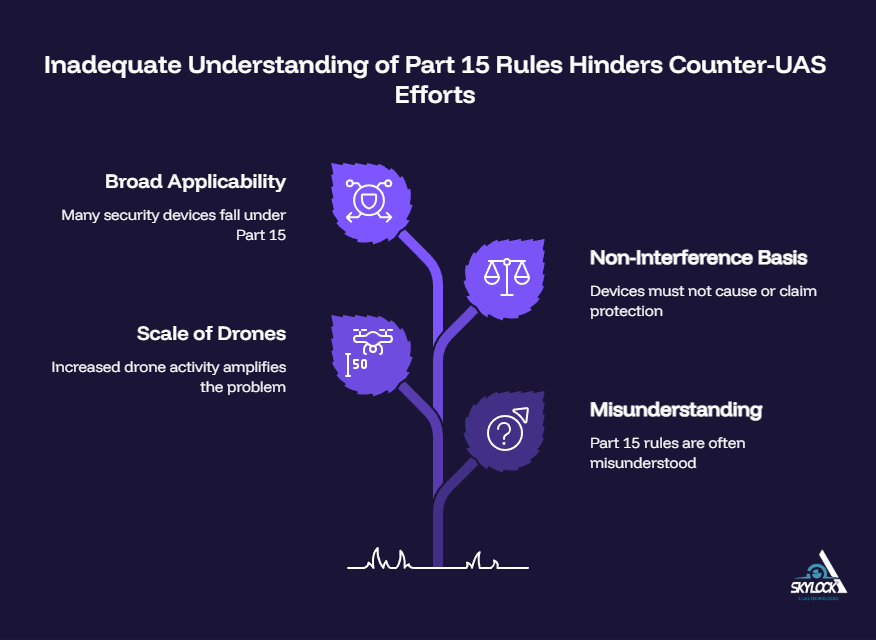
Many RF-enabled security, communications, detection, and situational awareness devices used in the U.S. may operate under FCC Part 15. But Part 15 is often misunderstood. It allows certain RF devices to operate without an individual FCC license, but only under strict conditions. These devices must not cause harmful interference, and they must accept interference received, including interference that may cause undesired operation.
For counter-UAS programs, that distinction matters. Compliance is not a paperwork exercise. It shapes how systems are evaluated, where they can be deployed, how they are integrated, and what response options are legally and operationally available.
What are FCC Part 15 rules?
47 CFR Part 15 governs radio frequency devices that operate without an individual FCC license. It applies to intentional, unintentional, and incidental radiators and sets administrative and technical rules for marketing Part 15 devices.
In plain language, Part 15 allows certain RF devices to operate without a dedicated license, but only on a non-interference basis. These devices must not cause harmful interference, and they cannot claim protection from interference in the same way licensed services can.
- Intentional radiators: devices that deliberately emit RF energy, such as certain wireless transmitters
- Unintentional radiators: devices that generate RF energy internally but do not intentionally transmit it
- Incidental radiators: equipment that may generate RF energy as a by-product of operation
Who needs to understand Part 15 FCC rules?
Part 15 matters to anyone in the United States who evaluates, buys, integrates, or operates RF-enabled security technology. This includes security leaders evaluating RF-enabled detection systems, procurement teams comparing counter-UAS platforms, technical evaluators assessing FCC authorisation and interference risk and systems integrators connecting sensors, communications and C4I workflows.
It is especially relevant for airports, ports, critical infrastructure, and public-sector organisations operating in crowded RF environments, where interference risk can affect mission continuity.
The two Part 15 rules every buyer should understand
Part 15 becomes easier to understand when buyers focus on two operating conditions. These rules matter because they affect more than device compliance. They influence site design, system integration, operational reliability, and the behaviour of RF-enabled security systems once deployed.
1. The device must not cause harmful interference
A Part 15 device is allowed to operate only if it does not cause harmful interference to authorised radio communications. If harmful interference occurs, the operator may need to stop using the device, change its deployment, or correct the problem before continuing operation.
For buyers, this means FCC compliance should not be treated as a one-time paperwork check. A device may be properly authorised for marketing, but the deployment still needs to account for the real RF environment around the site. Airports, ports, critical infrastructure facilities, public safety networks, and urban security environments often operate in proximity to sensitive or mission-critical communications.
The procurement question is not only, “Is this device compliant?” It is also, “How will this system behave here?”
2. The device must accept interference
Part 15 devices must also accept interference from authorised radio services and other compliant RF sources. In plain language, this means a Part 15 device cannot demand protection from interference in the same way a licensed service can.
That matters for counter-UAS and RF-enabled detection systems. Crowded RF environments can affect signal quality, detection confidence, communications links and operator workflows. When deployed near aviation systems, maritime communications, cellular networks, public safety radios, industrial equipment or dense urban infrastructure, a system that works well in a controlled test may require additional planning.
Part 15 compliance does not guarantee reliable performance. It defines the conditions under which the device may operate. Even with good system design principles, RF planning, sensor placement, interference testing, integration testing and fallback procedures at each site are still needed to maintain mission continuity with changing signal conditions.
Part 15 compliance is not the same as counter-UAS authority
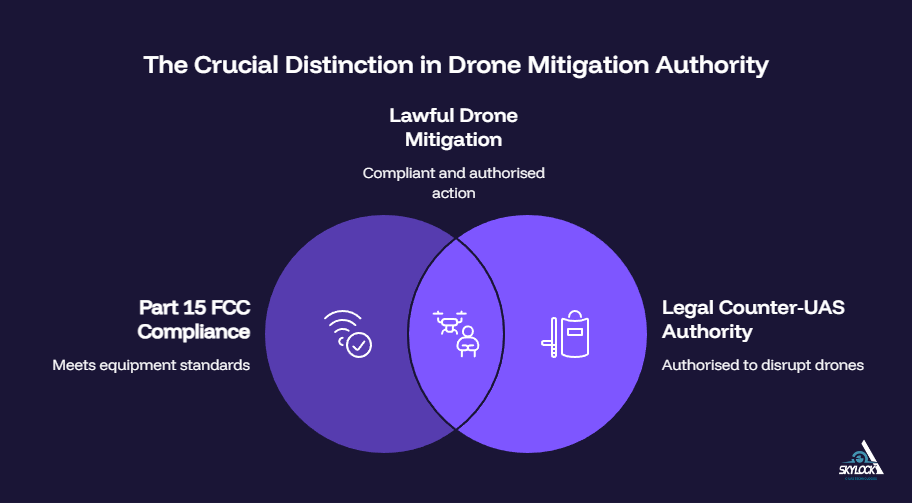
Compliance with Part 15 answers one narrow question: whether a radio frequency device complies with the applicable FCC equipment rules for operation, marketing, or importation under specified conditions. It does not answer separate question: whether the organisation using that device has legal authority to disrupt, jam, spoof, take control of, or disable drone.
A counter-UAS component can be authorised or compliant as an RF device and still be unlawful for a private operator, airport, critical infrastructure site, or local security team to use for mitigation. The FCC is clear that jammers and similar devices designed to block, jam, or interfere with authorised radio communications are prohibited unless expressly authorised. The FCC also states that there are no exemptions for jammer use in a business, classroom, residence, or vehicle.
This distinction is critical for procurement. Detection, verification, and evidence capture are not the same as RF disruption, takeover, or mitigation. However, some RF detection functions may still require legal review if they capture, decode, record, or intercept communications between a UAS and its controller. Detection and mitigation raise different legal and operational issues, so neither should be treated as automatically authorised.
Drone mitigation can create legal issues beyond Part 15, including communications law, aviation safety, surveillance law, property law, aircraft interference, and agency-specific authority. The interagency advisory from the FAA, DOJ, DHS, and FCC recommends a legal and technical review before the purchase, testing, installation, or use of UAS detection or mitigation systems.
A “Part 15 compliant” label does not mean you can neutralise drones. For buyers, the practical rule is simple: don’t assume. Design the counter-UAS process around compliant detection, validated identification, clear escalation, audit-ready evidence, and an approved response path. Mitigation should only be available where legal authority, rules of engagement, operational regulations, and site-specific safety constraints allow it.
Why Part 15 matters for drone detection systems
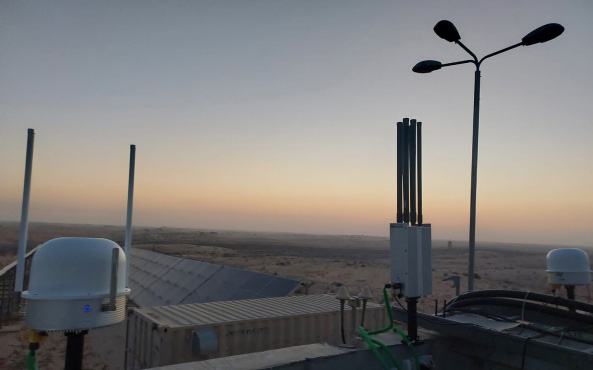
Drone detection systems are rarely a single device. A counter-UAS deployment may include RF sensors, radar, EO/IR cameras, processors, communications links, and C2 or C4I interfaces. Some components may emit radio frequency energy. Others may be passive receivers, optical systems, or software layers that correlate sensor data into an operational picture. Buyers should not assume every RF-emitting component is a Part 15 device. For example, UAS detection radar may require FCC licensing under the Radiolocation Service, depending on frequency, use case, and operator status. Each transmitting component should be mapped to the applicable FCC rule part before procurement or deployment.
That mix matters because different components can raise different compliance questions. Before procurement or deployment, buyers should understand:
- Whether the equipment requires FCC equipment authorisation before marketing or import
- Whether emissions limits apply
- Whether the device uses unlicensed bands
- Whether the system could interfere with licensed services
- Whether the deployment environment has RF congestion or sensitive communications nearby
The FCC rules are clear that radio frequency devices must be properly authorised under 47 CFR Part 2 before they are marketed or imported into the U.S. Part 15 also prohibits the operation or marketing of non-compliant intentional or unintentional radiators unless an exemption applies.
This is where multi-layer architecture becomes important. Drone detection should not rely on a single RF method. Radar, RF sensing, EO/IR verification and C4I correlation mitigate over-reliance on a single signal source. This supports a stronger detect–verify–respond workflow, giving operators better airspace awareness, faster verification, lower false-alarm burden, and a more defensible escalation path.
8 Compliance questions to ask before procurement
Before buying an RF-enabled drone detection or counter-UAS platform, buyers should ask practical compliance questions early. The goal is not legal interpretation. It is procurement discipline: confirming that the system can be evaluated, deployed, and operated without avoidable interference, authorisation, or escalation gaps. This should also include supplier risk mitigation, especially when vendors provide RF components, software integrations, remote support, or access to operational security environments.
1. What RF components does the system include? Ask which parts transmit, receive, process, or relay RF signals. This may include RF sensors, radar, communications links, gateways, or control interfaces.
2. Has the equipment been properly authorised for the U.S. market?
Confirm FCC equipment authorisation, labelling, documentation, and import status where relevant. Do not rely on general claims of compliance without supporting records.
3. Does the system rely on passive detection, active emission, or both?
Passive RF monitoring has different operational considerations than active emitting systems. Buyers should understand which functions listen, which transmit, and how each one is used.
4. Does any radar or RF-emitting component require a separate FCC licence?
Ask vendors to identify the applicable FCC rule part, frequency bands, operating locations, equipment authorisation status, and whether a Radiolocation Service licence or other authorisation is required.
5. Could the system affect licensed communications?
Consider nearby aviation, public safety, cellular, maritime, GPS/GNSS, and site communications. This is especially important in airports, ports, urban facilities, and critical infrastructure environments.
6. Are mitigation functions physically or administratively separated?
Detection and verification may be deployable where mitigation is not authorised. Separation helps prevent misuse and supports clearer operating procedures.
7. Who has legal authority to activate mitigation?
Define this before deployment. Do not leave it to the operator during an incident.
8. How is evidence captured and logged?
The system should support auditability, incident review, and defensible decision-making.
How compliant counter-UAS workflows should be designed
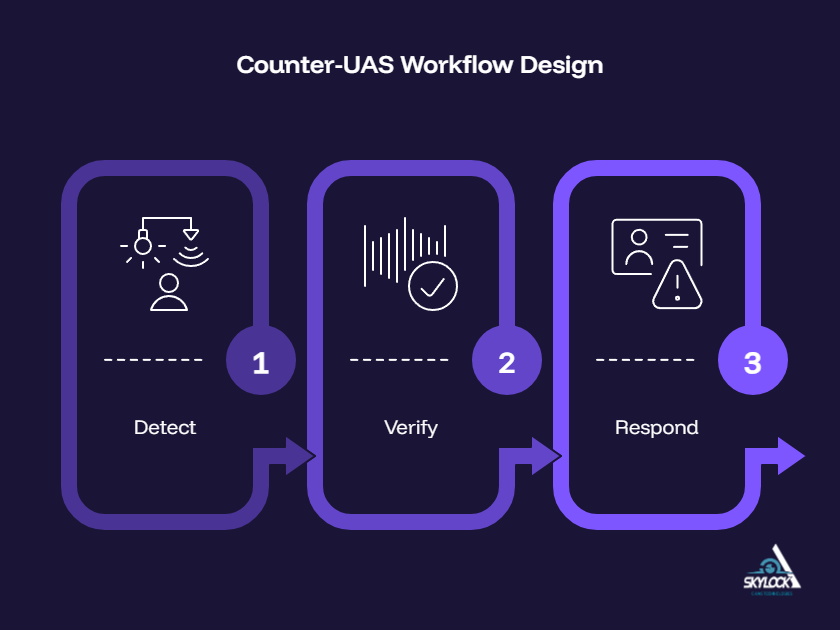
A compliant counter-UAS workflow should prioritise decision quality, not only detection range. The system should help operators move from first alert to verified assessment to an appropriate response without creating interference, safety, or authority risks. For security leaders, the working model is simple: detect, verify, respond.
Detect
Detection should provide early warning through sensor layers selected for the site, mission, and threat profile. A critical infrastructure site, airport perimeter, port, border zone, or temporary public-sector deployment will each have different coverage requirements. For sites where drone risk intersects with perimeter security, the same planning discipline applies: define approach routes, blind spots, line of sight, and operational constraints before selecting sensors.
Performance depends on terrain, clutter, the RF environment, line of sight, target profile, and local operating constraints. RF sensing can help detect control or telemetry activity where those signals are present. A drone detection radar can support wide-area track generation, especially where early warning and persistent tracking are required. EO/IR visual systems can assist in confirmation after cueing. No single sensor should carry the full detection burden. The goal is a layered operating picture that gives teams enough time to assess the event.
Verify
Verification reduces false alarms and supports a proportionate response. A radar track or RF alert should not become an incident response trigger without contextual support. EO/IR confirmation, RF correlation, track continuity and operator review all assist in differentiating drones from birds, clutter, authorised aircraft, maintenance activity or other benign sources.
This is where C4I integration matters. When alerts, tracks, camera views, and event logs feed into a common workflow, operators do not have to move between disconnected screens under pressure. This speeds verified identification, reduces operator burden, and creates a stronger audit trail.
Respond
Response should not default to neutralisation. Depending on the organisation and site, the response may include continued monitoring, escalation to security leadership, law enforcement notification, airside coordination, ground security action, temporary operational changes, or mitigation where authorised.
All mitigation must remain within legal authority, rules of engagement, operational regulations, and site-specific safety constraints. In the U.S. airport environment, mitigation requires additional caution. FAA guidance currently does not support the use of C-UAS mitigation systems by entities other than the federal departments with explicit statutory authority: Defense, Homeland Security, Justice, and Energy. Airport operators should coordinate detection and response planning with FAA, ATC, TSA, airport operations, and law enforcement. The workflow should define approval authority before an incident occurs. This is also where unified policies matter: every operator, supervisor, and response partner should work from the same approved rules, escalation thresholds, and audit requirements. SKYLOCK’s multi-layer approach supports this structure by combining detection, verification, C4I integration, operator-light workflows, evidence capture, and ROE-aligned response into a mission-ready counter-UAS process.
Common Part 15 mistakes to avoid
The Part 15 rules are often misunderstood in counter-UAS procurement. The most common mistakes are not technical details. They are assumptions that lead to poor buying decisions, risk of interference, or unlawful response planning.
- Assuming “unlicensed” means “unregulated.” Part 15 devices may operate without an individual FCC license, but they still must comply with strict conditions.
- Treating FCC equipment authorisation as operational approval for every use case. A compliant device still needs to be deployed correctly for the site, environment, and mission.
- Confusing detection compliance with mitigation authority. Detecting, tracking, and verifying drones is not the same as being authorised to disrupt or disable them.
- Buying imported RF equipment without confirming FCC authorisation. Marketing or importing non-compliant RF devices can create regulatory and operational exposure.
- Deploying RF systems without a site survey. Terrain, clutter, spectrum congestion, and nearby communications can all affect performance.
- Ignoring interference risk in sensitive environments. Airports, ports, public safety networks, and critical infrastructure sites need extra RF planning. For operators reviewing critical infrastructure security best practices, low-altitude airspace should be treated as part of the security perimeter, with detection, verification, escalation, and authorised response planned before an incident occurs.
- Assuming jamming is lawful because the threat is serious. Serious risk does not create legal authority to jam.
- Assuming radar is licence-free because the article is about Part 15. Some radar-based UAS detection systems may require separate FCC licensing or coordination, and should be reviewed component by component.
Build a Counter-UAS Workflow You Can Stand Behind
Part 15 compliance is not a loophole for legal authority, interference planning, or mitigation constraints. It tells buyers how certain RF devices can be used, but does not authorise every counter-UAS action or remove the need for site-specific planning.
For security teams assessing counter-UAS systems, the goal is not only to detect drones. It is to develop a workflow that supports verified identification, auditability, escalation, and authorised response under real operating conditions.
SKYLOCK helps organisations design multi-layer counter-UAS workflows that combine detection, verification, C4I integration, operator-light decision support and ROE-aligned response. Talk to SKYLOCK about evaluating your drone threat profile, RF environment, operating constraints, and compliant counter-UAS deployment path.