Anti-Drone Guns: Top 13 anti-drone guns and counter-UAS response solutions by use case
 The Skylock Team
Abstract: An anti-drone gun is a portable counter-UAS effector, most often handheld or shoulder-fired, designed to disrupt a drone’s control, telemetry, video, or navigation links where authorised. The device is only part of the decision for buyers. You also need to assess who can use it, where it can transmit, how the drone is verified, and how the response is coordinated.
This guide covers the top anti-drone gun and counter-UAS response solutions by use case, including:
- Integrated counter-UAS command and fixed-site defence
- Handheld RF response for patrol and perimeter teams
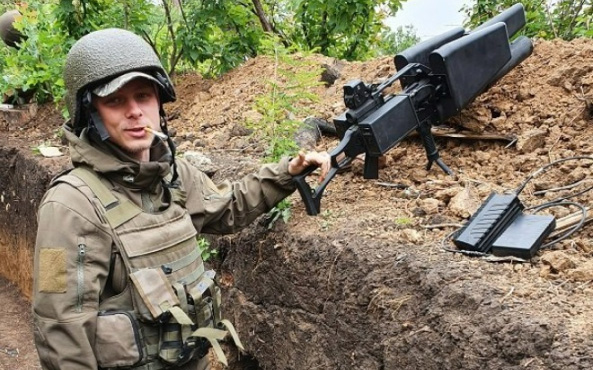
- Rifle-style RF mitigation for military, border, and field operations
- Mobile convoy and temporary protection zones
- Close-in tactical and last-layer defeat
A drone gun is not a complete counter-drone system. It is one response tool in a wider operational chain, and it only becomes useful after a target has been detected, verified, and cleared for action under the right authority, rules of engagement, and site conditions.
FAA data shows the agency receives more than 100 UAS sighting reports near airports each month. Drone sightings near airports are operationally sensitive because proximity to runways, approach paths, and controlled airspace can create safety, disruption, and response-coordination risks.
That is why procurement should not start with the strongest output or longest claimed range. The starting point should be mission fit. That means looking at terrain, RF conditions, who will operate the system, what authority they have, and how the response will unfold.
What is an anti-drone gun?
An anti-drone gun, or drone rifle, is a directed, point-use counter-UAS effector designed to disrupt, deter, or compel a drone response where authorised. Most are portable systems carried by a trained operator, although some are weapon or vehicle-mounted or integrated into broader fixed-site systems.
The term is often used loosely. Some “anti-drone guns” are RF disruption devices. Others are smart jammers, GNSS disruption tools, kinetic fire-control sights, or portable elements within a larger counter-UAS architecture. They should not be treated as interchangeable.
In a mature security environment, an anti-drone gun is not the first layer of protection. It comes later, once the drone has been detected, tracked, and verified as a likely unauthorised target. Integration matters because the effector should be tasked from a shared operational picture. Actions should also be logged for command review, audit, and post-incident analysis.
What can anti-drone guns do?
Depending on configuration and legal authority, anti-drone guns can be designed to disrupt control links, telemetry, video transmission, or satellite navigation reception. Depending on the drone, electronic disruption may cause it to hover, return home, or land. Others provide kinetic response options, usually as part of a wider layered system.
The operational effect depends on the target profile, signal environment, line of sight, weather, clutter, local regulations, and the drone’s programmed failsafe behaviour.
What anti-drone guns do not do?
Anti-drone guns do not replace the necessity for detection, tracking, or verification. They do not guarantee safe outcomes in airports, dense urban areas, crowds, maritime environments, or congested RF conditions. These devices also do not provide the legal authority to mitigate threats, as they function solely as response tools rather than comprehensive perimeter security or complete counter-UAS systems.
The non-negotiables before you shortlist “drone guns”
Authority, ROE, and regulatory alignment
In many places, jamming, spoofing, RF disruption, taking control of a drone, or physically defeating it is limited to authorised bodies. Some sites may need specific legal authority before any of those actions are used. U.S. interagency guidance makes the same point.
Organisations should get legal advice and review the technical risks before testing, buying, installing, or using UAS detection or mitigation systems. For procurement teams, this is not only a technical decision. It is a compliance risk management issue that requires clear ownership, documented authority, site-specific safety constraints, and evidence requirements before any effector is evaluated.
The big red line on jamming language
The FCC states that intentionally using a jamming device to block or interfere with authorised radio communications violates U.S. federal law and that there are no general exemptions for businesses, residences, classrooms, vehicles, or local law enforcement.
This does not mean RF mitigation has no role in a drone swarm defence strategy. It means the role must be lawful, authorised, controlled, logged, and aligned with mission risk. Because unauthorised jamming carries severe penalties and risks of collateral damage to critical communications, your strategy should prioritise detection, classification, and coordination with the appropriate authorities over immediate active mitigation.
Operational environment fit
The requirement changes with the mission environment. A prison perimeter, naval pier, airport approach path, forward operating base, data centre and VIP event all have different risks, RF constraints, collateral concerns, operator demands and response timelines.
Top picks at a glance by use case
- Recommended for integrated counter-UAS command and fixed-site defence: Skylock, for coordinating detection, verification, response tasking, audit logging, and C4I integration.
- Recommended for handheld RF response for patrol and perimeter teams: DroneShield DroneGun Mk4, for trained teams that need a compact portable mitigation tool after target verification.
- Recommended for rifle-style RF mitigation for military, border, and field operations: SkyWiper EDM4S, for authorised tactical teams that need a mobile rifle-style response option.
- Recommended for mobile convoy and temporary protection zones: CERBAIR CHIMAERA 200, for mobile units, convoys, and temporary deployments requiring field-ready RF detection and mitigation.
- Recommended for close-in tactical and last-layer defeat: Smart Shooter SMASH, for authorised armed teams that need a kinetic last-layer option under strict ROE and safety conditions.
Top 13 anti-drone gun and counter-UAS response solutions by use case
Category 1: Integrated counter-UAS command and fixed-site defence
This category covers full counter-UAS architectures, not standalone drone guns. These solutions are best suited for sites where response cannot depend on a single operator visually identifying a drone and deciding what to do next.
They support the wider operational chain such as detection, tracking, verification, response tasking, audit logging, and integration into C2, C4I, PSIM, VMS, SOC, or wider command environments. This category is most relevant for airports, defence facilities, borders, ports, critical infrastructure, and national security sites where incidents need to be managed through a governed workflow.
The key procurement question is not “which effector is strongest?”, but whether the system provides operators with a verified operating picture that allows authorised response actions to be effectively coordinated, logged, and reviewed as part of your risk monitoring strategy.
1. Skylock – Recommended for Multi-Layer Counter-UAS Response Orchestration

Skylock is not a standalone anti-drone gun manufacturer. It belongs in this comparison because handheld and directional effectors only work well when the wider response chain is in place. Skylock combines detection, verification, response tasking, logging and C4I integration into a single Counter-UAS workflow. Operators are given a validated picture of the target before mitigation is applied. Procurement teams are provided with a platform built around sensors, EO/IR verification, authorised response options and command coordination in line with ROE.
Key Strengths:
- Coordinates detection, verification, and response rather than treating mitigation as a standalone action.
- Integrates with C4I, PSIM, VMS and third-party sensors to minimise disconnected operator workflows.
- Helps ensure mitigation actions are logged, governed, and aligned with site authority and ROE.
Key Limitations:
- It is not a single portable “gun”; the value of Skylock lies in the complete architecture, integrated sensors, and authorised effectors.
- Early warning and response performance depends on deployment design, terrain, sensor placement, RF conditions and local authority.
Pricing: Custom deployment pricing based on site architecture, sensor mix, integration requirements, and sustainment model.
2. ST Engineering AGIL Counter Drone – Recommended for Public Security and Infrastructure Counter-Drone Operations
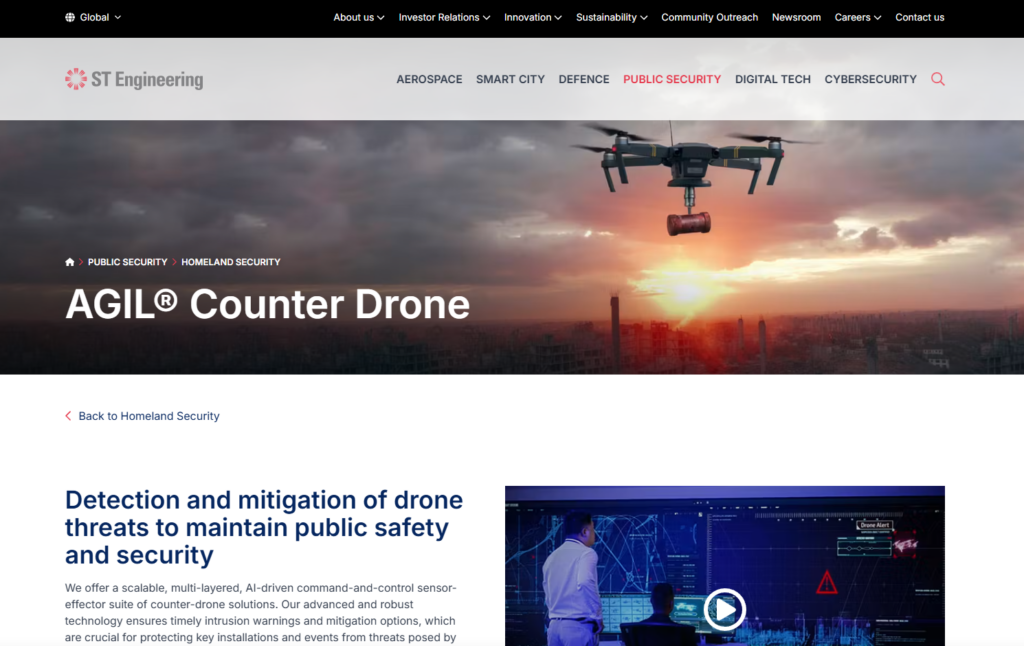
ST Engineering AGIL Counter Drone is a scalable multi-layer counter-drone suite built around detection, decision support, disruption, and defeat. ST Engineering describes it as an AI-driven command-and-control sensor-effector suite with radar, RF directional finding, EO/IR sensors, C2, RF jammers, drone interception, and laser effector options.
Key Strengths:
- Covers the whole detect-decide-disrupt-destroy chain.
- C2 layer integrates detection, tracking, and mitigation modules into a unified operator interface.
- Offers flexible effectors, including RF jamming and other defeat options.
Key Limitations:
- Not a simple “drone gun” purchase; procurement depends on selected architecture and effectors.
- Larger system deployments require integration planning, training, and sustainment.
Pricing: Custom system pricing based on deployment scale and selected modules.
3. Rafael Drone Dome – Recommended for Fixed-Site Defence and Strategic Facility Protection
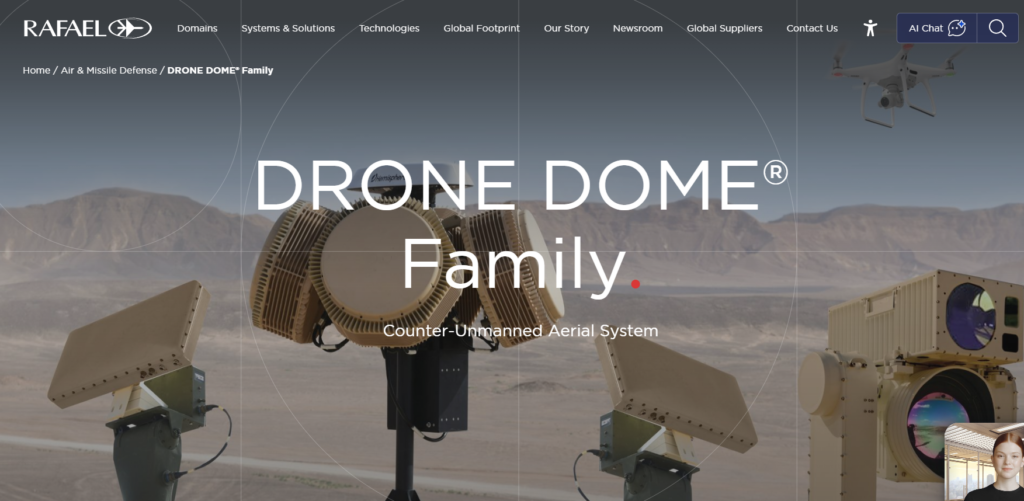
Rafael Drone Dome is an end-to-end modular C-UAS system designed for 360-degree defence against hostile drones. Rafael describes the system as integrating radar, SIGINT/RF sensors, EO sensors, jamming, and a C4I centre, with soft-kill and hard-kill options depending on configuration. Leveraging such specialised systems is a common strategy when working with managed security service providers, as they help organisations maintain high-level protection without having to manage the full technical complexity of a diverse sensor network in-house.
Key Strengths:
- Provides a full system-level C-UAS architecture rather than an isolated effector.
- Integrates detection, identification, classification, neutralisation, and interception workflows.
- C4I centre supports coordinated sensor-effector management.
Key Limitations:
- Larger procurement footprint than handheld-only systems.
- Requires formal integration, infrastructure planning, training, and lifecycle sustainment.
Pricing: Formal defence procurement pricing based on system configuration, sensors, effectors, and sustainment requirements.
Category 2: Handheld RF response for patrol and perimeter teams
This category covers portable handheld systems designed for trained teams that need a fast point-of-use response after a drone has already been detected and verified.
These tools are most relevant for dismounted patrols, perimeter teams, public-safety units, major-event security, and quick reaction forces. They are useful when operators need a compact device that can be carried, aimed, and activated quickly within a defined response window.
Their limitation is also clear: they are not complete counter-drone systems. They should not be used as the primary detection layer or as a substitute for verification. Their effectiveness depends on the authority to transmit, line of sight, RF conditions, drone link architecture, and the site’s rules of engagement.
4. DroneShield DroneGun Mk4 – Recommended for Compact Dismounted RF Response
DroneShield’s DroneGun Mk4 is a handheld counter-drone device built for mobile teams that need a fast-response option in the field. It is best suited to trained patrols, perimeter teams, and quick reaction forces that already have detection and verification in place. The Mk4 is DroneShield’s handheld option in its DroneGun line. It weighs 3.37 kg and is battery-operated, has a quick start, and is IP67 rated.
Key Strengths:
- Compact and lightweight form factor for dismounted operators and mobile patrols.
- Fast start-up for short response windows after verification.
- Ruggedised design suited to field conditions.
- Carry-case packaging supports rapid deployment and transport.
Key Limitations:
- RF mitigation is still very much dependent upon legal authority, target link architecture, spectrum conditions and line of sight.
- Battery endurance and operator recharging procedures must be built into shift planning.
- It should be cued by verified detection rather than used as a visual-search tool.
Pricing: Available through DroneShield sales channels.
5. DedroneDefender 2 – Recommended for Smart RF Mitigation in Urban and Frontline Operations
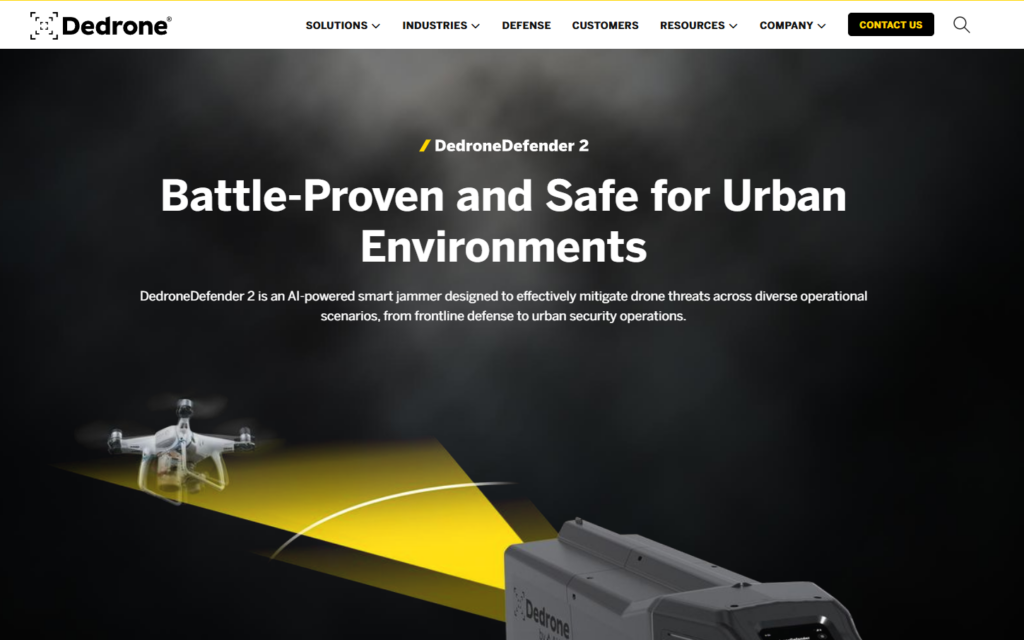
DedroneDefender 2 serves as Dedrone’s handheld smart drone mitigation jammer, engineered specifically for teams with an established detection-led process. Because the operator responds to a verified target rather than acting on visual sighting alone, the tool is better suited for organised security and defence teams than for ad hoc field use. Before any mitigation tool is used, teams need a reliable detection and verification layer, whether radar-led, RF-led, EO/IR-led, acoustic-assisted, or multi-sensor. This ensures response actions are based on a verified target and aligned with legal authority, ROE, and the broader security mission.
Key Strengths:
- Designed for controlled mitigation across diverse operational environments.
- Well-suited to urban security and frontline response, where precision and auditability are key.
- Stronger procurement fit when paired with a wider detection, tracking, and command workflow.
Key Limitations:
- Best evaluated as part of the wider Dedrone ecosystem, not as an isolated device.
- RF mitigation remains constrained by legal authority, spectrum rules, and local site risk.
Pricing: Custom pricing through Dedrone/Axon channels.
6. Phantom Technologies DroneShoot800 – Recommended for Directional Handheld RF Mitigation
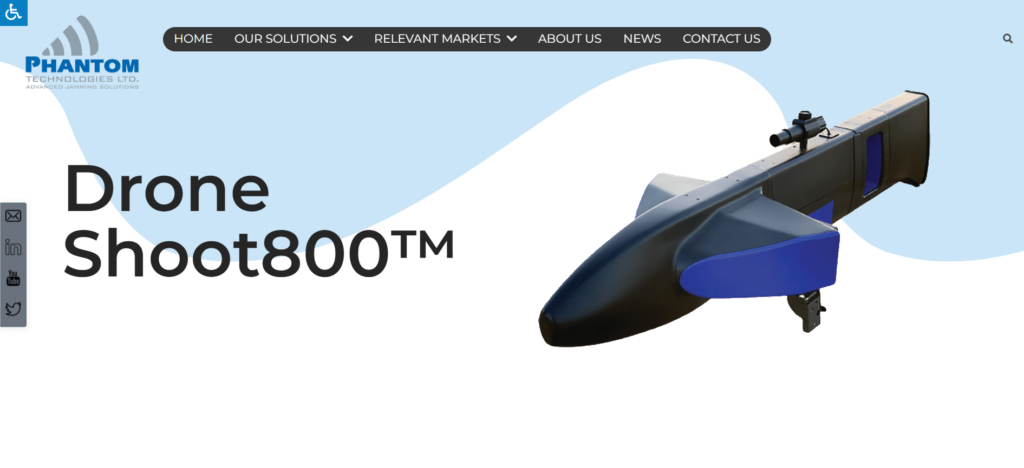
Phantom Technologies’ DroneShoot800 is a handheld RF jamming rifle for counter-drone applications. Phantom says it’s a directional system that jams drone control, Wi-Fi/ISM, and GNSS signals, including GPS L1 and L2. It is ideally suited for authorised teams who require a portable mitigation option once the drone has been detected and verified.
Key Strengths:
- Directional rifle-style design supports point-use response by trained operators.
- Targets common communication and navigation links used by many commercial drones.
- A simple handheld format can support border, compound, and mobile security applications.
Key Limitations:
- Effectiveness depends on the drone’s control architecture, autonomy, and signal environment.
- RF collateral risk must be assessed before deployment near critical communications or navigation systems.
Pricing: Available through Phantom Technologies or distribution channels; pricing should be confirmed directly.
Category 3: Rifle-style RF mitigation for military, border, and field operations
This category covers field-ready, rifle-style systems designed for tactical operators working in military, border, or remote-site environments.
These solutions are generally more relevant where operators are already trained for field movement, weapon-like handling, and structured ROE. They are suited to border patrols, forward operating areas, base protection, remote infrastructure, and sensitive-site defence where portability, ruggedisation, and rapid activation matter.
The main evaluation point is mission fit. Buyers need to confirm whether the system can operate in the actual terrain, RF environment, and authority structure of the deployment. RF-only response tools may be less effective against autonomous, pre-programmed, or RF-silent drones, so they should be paired with reliable detection and verification.
7. SkyWiper EDM4S – Recommended for Mobile Rifle-Style RF Mitigation
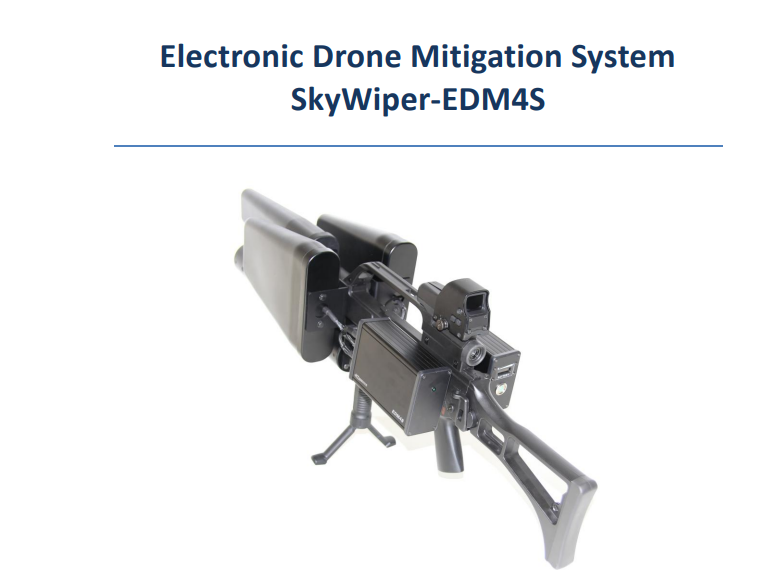
SkyWiper EDM4S is a portable electronic drone mitigation system designed to defeat remotely piloted aircraft systems by targeting control, video and navigation signals. It is mobile, integrated and ready to be activated by a rifle-style trigger, according to the manufacturer’s technical specification.
Key Strengths:
- Rifle-style form factor is familiar to military and tactical operators.
- Fully mobile design supports border, field, and patrol use cases.
- Integrated modules reduce the need for separate external components during deployment.
Key Limitations:
- RF-only effectors may be less effective against autonomous, pre-programmed, or RF-silent drones.
- Performance depends on line of sight, target link architecture, and local spectrum conditions.
Pricing: Formal procurement quotation through NT Service or authorised channels.
8. MC2 Technologies NEROD RF – Recommended for Dismounted Military Teams
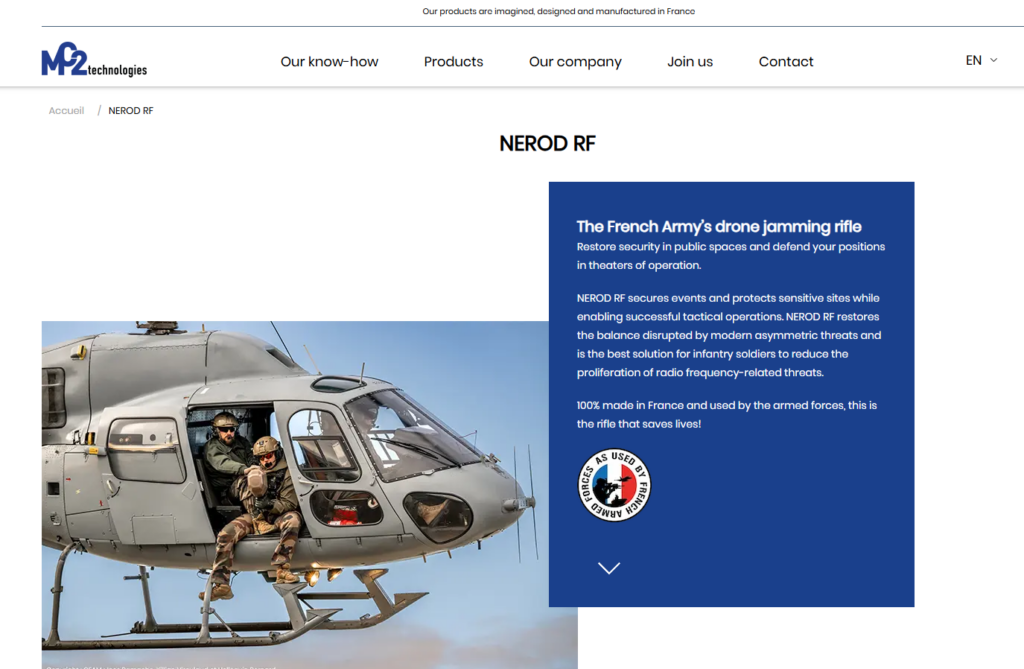
MC2 Technologies’ NEROD RF is a portable anti-drone rifle for authorised counter-UAS teams. MC2 describes it as a field-ready neutralisation system with wide multi-band coverage, a directional antenna cone, and a replaceable military-grade battery. The company also presents it as a complement to detection systems, making it a better fit for teams that already have a way to detect and confirm the drone before mitigation.
Key Strengths:
- Portable rifle-style form factor supports infantry and close-protection missions.
- Designed for rapid use by trained operators without complex infrastructure.
- Strong fit for sensitive-site and major-event response, where authorised.
Key Limitations:
- Still requires detection and verification support for confident engagement.
- RF mitigation effectiveness depends on drone type, link behaviour, autonomy, and operating environment.
Pricing: Available through MC2 Technologies procurement channels; pricing should be confirmed by configuration.
9. Battelle DroneDefender – Recommended for Legacy Handheld C-UAS Benchmarking
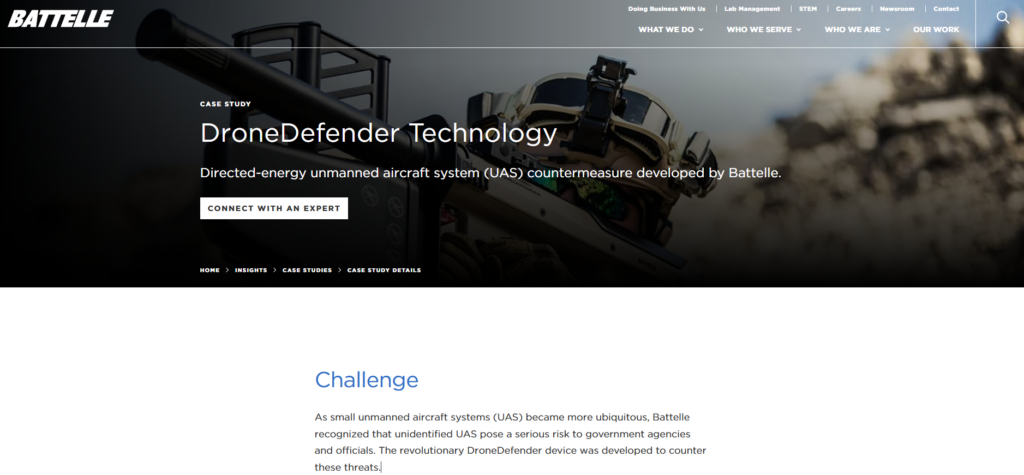
Battelle DroneDefender was among the first handheld counter-UAS devices to gain broad attention. Battelle describes it as a directed-energy UAS countermeasure that uses remote control and GPS disruption to stop unwanted drones. The system was lightweight, non-kinetic, and built around a point-and-shoot format. In 2019, Dedrone purchased the DroneDefender technology, including the associated assets and intellectual property.
Key Strengths:
- Established the operational logic behind handheld non-kinetic C-UAS response.
- Point-and-shoot format reduced training complexity compared with larger systems.
- The non-kinetic approach avoided the immediate debris risk posed by shooting down drones.
Key Limitations:
- Should be treated as a legacy technology reference, not assumed to be a current procurement option.
- Current availability, support, and sustainment must be verified.
Pricing: Not a typical current commercial procurement item, availability and licensing status must be confirmed directly.
Category 4: Mobile convoy and temporary protection zones
This category covers systems designed for moving assets, temporary deployments, and rapidly changing protection requirements.
These solutions are most relevant for convoys, mobile military units, VIP movements, temporary event perimeters, forward deployments, and asset protection missions where a permanent fixed-site architecture is not practical. The operating environment may change daily, so deployment speed, portability, vehicle integration, battery planning, and operator workload become central.
The main procurement issue is whether the solution can provide useful protection without creating coordination problems. Mobile and temporary missions still need detection, verification, authority checks, communications discipline, and incident logging. A rapidly deployed system should not mean an informal response workflow.
10. CERBAIR CHIMERA 200 – Recommended for Convoy and Mobile Unit Protection
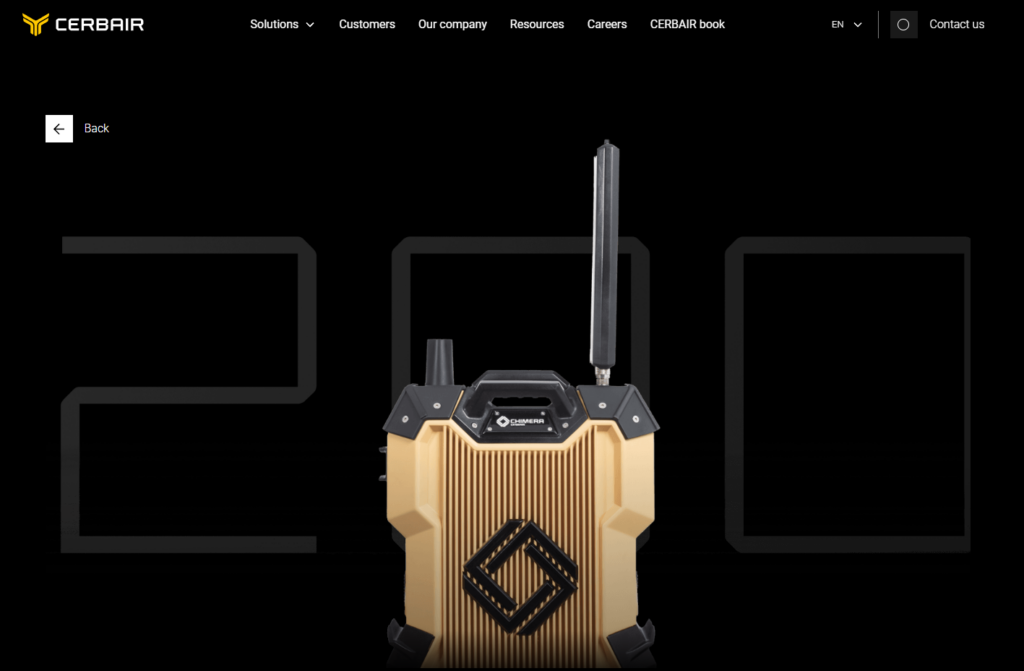
CERBAIR CHIMAERA 200 combines RF detection and neutralisation functions to provide mobile protection for troops, convoys and military facilities. CERBAIR says the system provides early drone detection and neutralisation, broad 400 MHz-6 GHz spectral coverage, omnidirectional detection, optional directional antennas, intelligent jamming waveforms and potential for vehicle integration. Adopting these advanced technologies is essential for modern critical infrastructure security best practices, particularly as threats become more mobile and diverse.
Key Strengths:
- Suitable for vehicle integration and mobile force protection.
- Broad RF coverage supports the detection of diverse drone communication profiles.
- Operator interface supports real-time alerting and drone/pilot localisation.
Key Limitations:
- RF mitigation must be assessed against friendly communications and local spectrum constraints.
- Requires operator training to interpret RF alerts correctly in cluttered environments.
Pricing: Custom project quotation based on deployment model and integration scope.
11. SkyFend Blader – Recommended for Portable Configurable Jamming
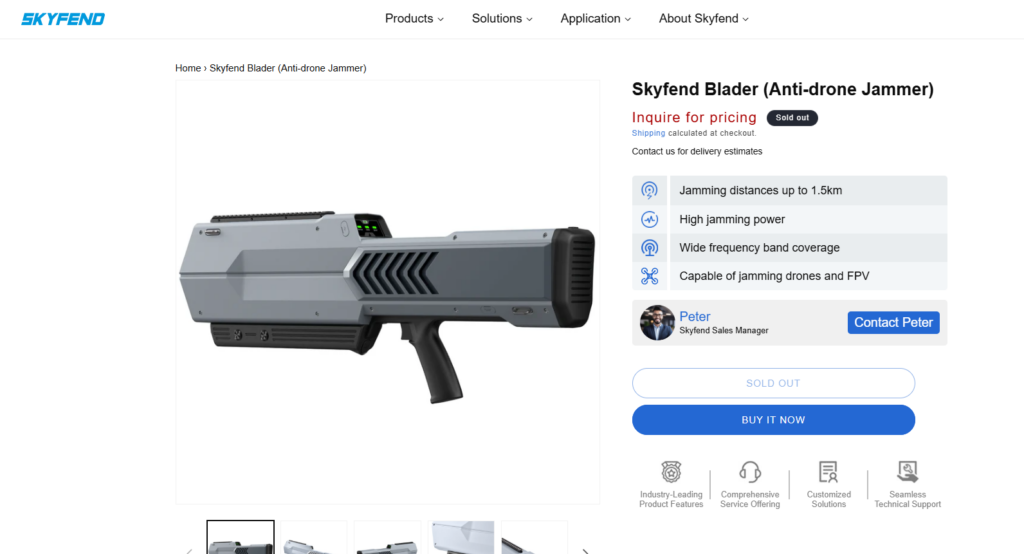
SkyFend Blader is a portable anti-drone jammer built for high-power RF mitigation. SkyFend describes it as a compact field tool with customisable frequency coverage and enough output to disrupt a range of multirotor and other UAV threats. The company’s materials point to use cases such as VIP protection, asset protection, and event security.
Key Strengths:
- The portable format supports temporary deployments and mobile protection teams.
- High-power configuration may be useful where authorised area denial is required.
- The commercial product page provides a clear baseline for procurement inquiry.
Key Limitations:
- High-power RF systems require especially careful legal, spectrum, and safety review.
- Public storefront availability and export conditions should not be assumed.
Pricing: Public storefront information is visible, but procurement teams should check pricing, availability, delivery, export controls and support directly with SkyFend.
Category 5: Close-in tactical and last-layer defeat
This category covers final-response tools used when the threat is close, the response window is short, and the operator has the authority, training, and safety conditions required to act.
These are not general-purpose site-security tools. They are best suited to military or authorised armed teams operating under strict ROE. Some tools in this category support weapon-mounted RF disruption, while others support kinetic engagement against small drones.
The key issue is control. Close-in defeat options require clear engagement authority, safe backstop planning, friendly-force deconfliction, operator qualification, and strong post-incident review. In crowded environments, airports, urban areas, or critical infrastructure sites, these tools may be unsuitable unless the engagement geometry and legal authority are clearly established.
12. Trust Automation Ghoul-Tool – Recommended for Weapon-Mounted Field-Level C-UAS
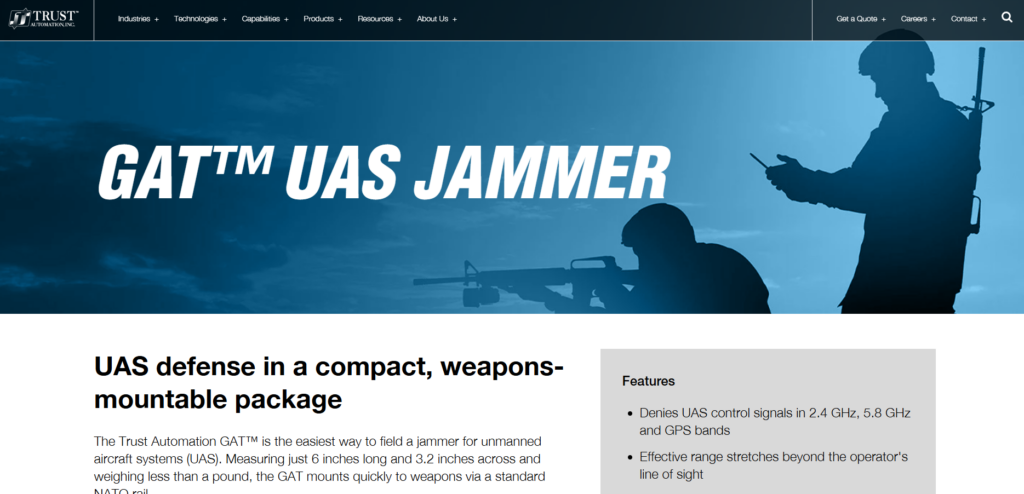
Trust Automation’s Ghoul-Tool Attachable Transmitter, or GAT, is a small, field-ready counter-UAS jammer that can be mounted to a weapon rail. The anti-drone gun is a weapon-mountable transmitter intended to jam hostile UAS activity via C2, RF and GPS/GNSS denial. Its best fit is close tactical response, where a trained operator needs a local mitigation option rather than a fixed-site system.
Key Strengths:
- Weapon-mounted format reduces the need for a separate handheld mitigation device.
- Suited to military field units that need C-UAS response at the individual or squad level.
- Supports direct response to UAS threats without shifting to a separate system.
- Fits tactical missions where operators already carry primary weapons and need added
- C-UAS capability.
Key Limitations:
- Military-specific use case with strict ROE, safety, and training implications.
- Integration with weapon handling procedures must be carefully controlled.
- RF/GNSS denial remains subject to legal authority and friendly-force deconfliction.
Pricing: Formal defence procurement processes required.
13. Smart Shooter SMASH – Recommended for Kinetic Last-Layer Drone Defence
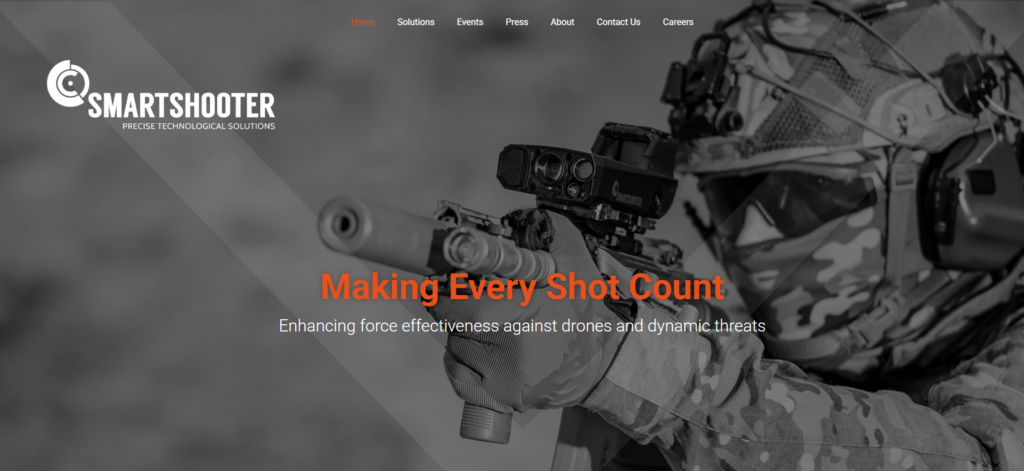
Smart Shooter SMASH is not an RF jammer. It is a fire-control system designed to help armed operators detect, track, lock, and hit moving targets, including small drones. Smart Shooter describes SMASH as a rifle-mounted fire-control solution that uses computer vision, target acquisition, tracking, and fire-control support to improve engagement against drones and other dynamic threats.
Key Strengths:
- Provides a hard-kill option when RF mitigation is unavailable, ineffective, or not authorised.
- Can be mounted on standard rifles, reducing the need for a dedicated launcher or effector.
- Useful as a last-layer defence option for trained armed teams.
Key Limitations:
- Requires clear kinetic engagement authority, safe backstop planning, and strict firearms discipline.
- Not suitable for crowded environments, airports, or infrastructure sites without a safe engagement envelope.
Pricing: Formal procurement quotation through Smart Shooter or authorised defence channels.
How we compared these solutions
The comparison is based on vendor information, public product pages, public datasheets where available, government guidance and credible defence industry reporting, with sources reviewed in June 2026. Performance in the real world is influenced by the target profile, terrain, line of sight, RF congestion, clutter, weather, configuration and local operating limits. We focused on the factors procurement teams need to test before selecting an effector:
- Time-to-effect inside a verified workflow: Once the drone is identified, tracked and verified, can the tool enable a timely response?
- Operator burden: How much training, aiming support, target handoff, and physical load does the operator need to manage?
- Collateral impact risk: What are the effects on nearby communications, navigation, people or assets of RF disruption, kinetic engagement or other system effects?
- Integration readiness: Can the incident be logged, shared, and escalated into C2/C4I, PSIM, VMS, or wider security operations workflows?
- Sustainment: Are batteries, spares, software updates, serviceability, and training supportable over the long term?
- Use-case fit: Does the solution fit the actual mission, whether that is an airport, public event, border, maritime site, convoy, prison, or fixed critical infrastructure facility?
Choose response capability, not just a device
Anti-drone guns are useful, but only if the rest of the response chain is already in motion. A device alone is not sufficient if the team still has to confirm the target, check authority, coordinate the response and record what happened under pressure.
Skylock’s value is in the workflow around the response. Detection, verification, tasking, and logging are connected before the effector is used. That helps operators understand what they are responding to, who has authority to act, and how the action fits into the wider command picture.
To evaluate which anti-drone gun class fits your mission, start with the workflow, then test the hardware inside it. Talk to a Skylock expert about building a mission-ready counter-UAS workflow around your site, team, and rules of engagement.