What is a drone swarm attack: Definition, examples, and protections
 The Skylock Team
Abstract
- A drone swarm attack uses multiple unmanned aerial vehicles that coordinate towards a shared objective through preplanned instructions, centralised control, or distributed autonomy.
- Coordination distinguishes true swarms from mass drone and saturation attacks, although both can overwhelm defences through simultaneous track volume.
- Sensor saturation, cost asymmetry, and operator decision overload make these attacks difficult to stop.
- Single-layer radar, RF, EO/IR, and manual systems leave operational blind spots.
- Effective protection requires layered counter-UAS capabilities that detect, verify, prioritise, and support authorised responses within a coherent operating picture.
One suspicious drone sets off a manageable process: find, activate camera, confirm identity, and escalate if needed. However, an event that looks like a swarm breaks that chain. A number of low-level tracks may show up while operators check the first one. Different cameras are being pulled in different directions, RF cues might not explain every object and the response team has to decide which tracks are most important before they can finish the picture.
That challenge is not confined to extreme or future scenarios. A systematic review of fixed ground-based aerial detection in airport environments screened 875 records and assessed 36 studies. No single sensor modality adequately detects low, slow, small targets in complex airport environments; layered sensor fusion is needed to close detection, classification, and situational-awareness gaps. Radar, RF, EO/IR, acoustic and other detection methods all have strengths, limits and blind spots. Layered sensor fusion has become a key to effective airspace awareness.
This is why drone swarm risk needs precise definition. The term is used loosely, but the defensive problem is specific: simultaneous low-altitude targets strain detection, verification, prioritisation, and response workflows. Knowing what constitutes a true swarm and where the operational effects overlap helps security teams prepare for the real pressure points.
What is a drone swarm attack?
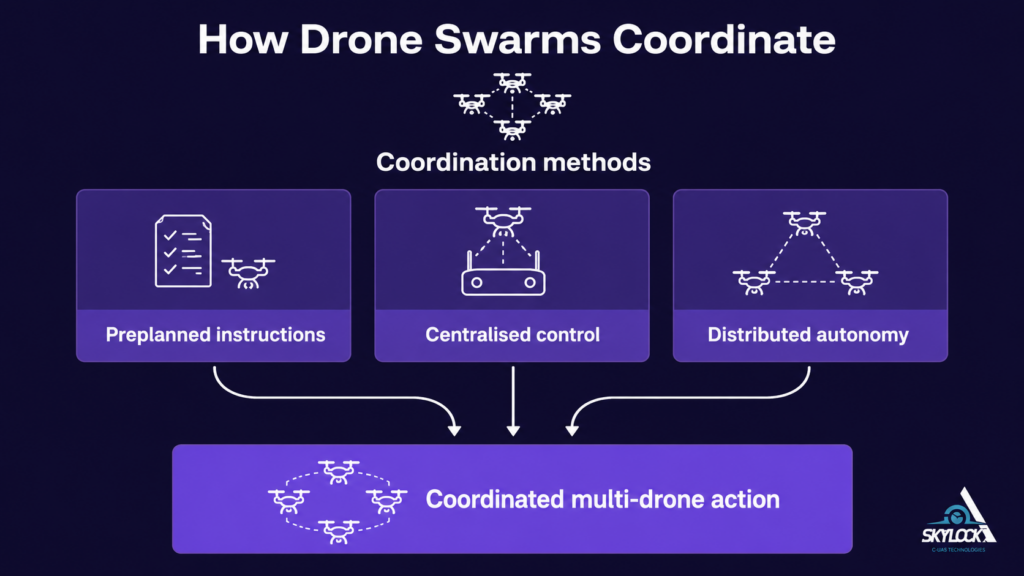
A true drone swarm attack involves multiple unmanned aerial vehicles coordinating toward a shared objective with limited human control. Instead of each drone being manually flown as a separate asset, the group operates with some level of coordination, using preplanned instructions, centralised control, or distributed decision-making across the drones.
That coordination is what makes a swarm different from a simple group of drones in the same area. The drones may follow a common route, divide tasks, adjust movement in relation to one another, or converge on a target from different directions. The level of autonomy can vary, and not every swarm is fully autonomous.
But in public reporting, “drone swarm” is often a looser term. Some events labelled as swarms are better understood as mass drone attacks, coordinated multi-drone attacks, or saturation attacks. This is a distinction that matters in that it keeps the terminology accurate. The operational problem for defenders is simple: multiple low-altitude objects can appear simultaneously, reducing the time to detect, verify, and respond.
Drone swarm vs mass drone attack: why the distinction matters
Multi-drone attacks are not necessarily swarms, and the difference matters because it affects detection assumptions, RF dependence, verification workflows and response planning.
| Threat type | What it means | How it operates | Why it matters for defenders |
| Drone swarm attack | Multiple drones coordinate and cooperate toward a shared mission objective. | The drones may use preplanned instructions, centralised control, or distributed autonomy to adjust movement, divide tasks, or converge on a target. | A coordinated swarm may be less reliant on continuous active command links and can generate a more adaptive threat picture, depending on its control architecture and autonomy level. Defenders require rapid correlation, verification, prioritisation and ROE-aligned response. |
| Mass drone attack | Many drones are launched toward one or more targets, but with limited cooperation between them. | The drones may follow preplanned routes, be remotely operated, or be released in large numbers to create pressure through volume. | Even without true swarm autonomy, massed drones can create too many tracks for manual systems to process quickly. |
Why drone swarm attacks are hard to stop
A drone swarm attack is difficult to stop because it changes the defensive problem from one suspicious object to many simultaneous tracks. A single rogue drone may give operators time to detect, classify, verify, and respond. Multiple drones arriving from different directions reduce that time and increase the pressure on every part of the security workflow.
The top 3 challenges are:
1. Saturation
Even when sensors detect multiple objects simultaneously, detection is not enough. The system must maintain track quality, correlate the inputs, and help the operators understand which tracks are real threats. Verification is slowed down by fragmented or uncertain track data.
2. Cost asymmetry
Defenders may have to counter lower-cost platforms with expensive sensors, interceptors, or response assets. That imbalance can quickly drain response resources, especially if the attack is designed to generate volume, not precision.
3. Decision overload
Operators cannot manually inspect every track, slew every camera and prioritise every response fast enough when the air picture is changing by the second. This creates a verification bottleneck where teams know something is going on, but it becomes harder to confirm what is important and to act in the right order.
Effective perimeter security defence depends on faster workflows for detection, verification and response that reduce the manual burden and allow for prioritised, ROE-aligned action.
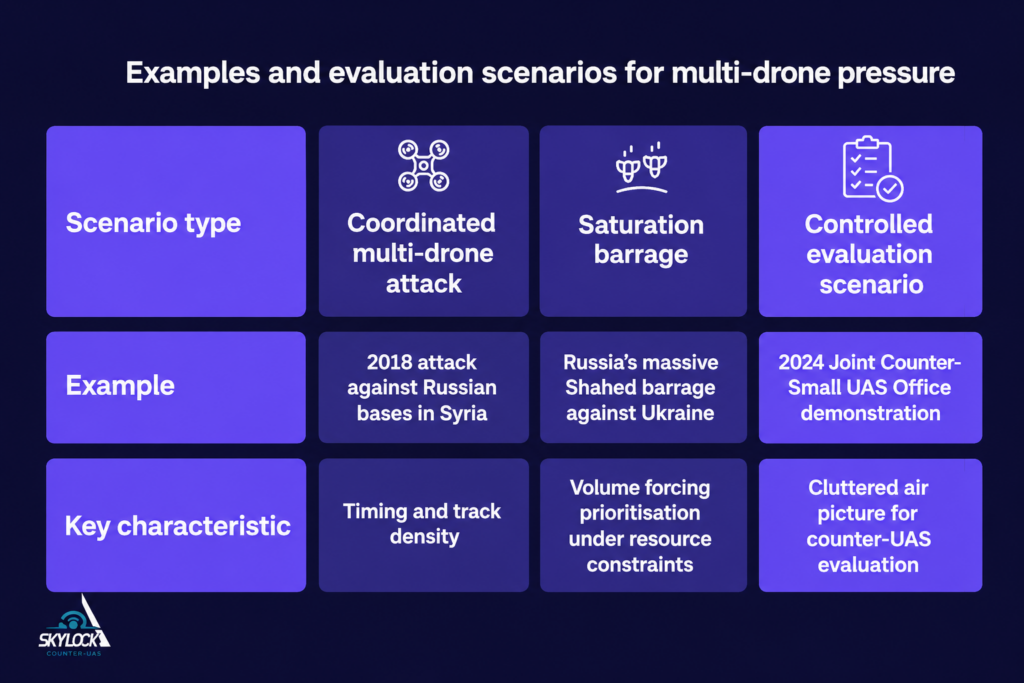
Real-world examples of swarm-style, coordinated, and saturation drone threats
In public reports, any incident involving several drones is usually referred to as a “drone swarm.” That label is not specific enough for defenders. But a real swarm means coordination between drones, whereas a mass drone attack can be based on volume, timing, and multiple approach routes without actual cooperation between the aircraft.
The operational pressure might still look similar. Multiple low-level tracks appear at once. The sensor cues come from different sources. Operators need to discriminate drones from clutter, prioritise the most relevant tracks and validate what response is permitted before the threat picture changes.
Coordinated multi-drone attack
The 2018 attack against Russian bases in Syria is often cited as an early drone swarm case. This is better characterised as a coordinated multi-drone attack on defended sites.
For security teams, it’s the timing and track-density problem that is relevant. As multiple small UAVs converge on a protected area, the defensive workflow must move beyond detecting isolated objects. Operators must track correlation, camera cueing, verified identification and escalation simultaneously. Even relatively simple drones can cause a loss of decision time when a system is dependent on one-by-one manual verification.
Saturation barrage
Russia’s massive Shahed barrage against Ukraine demonstrates the potential threat of massed drones to air defence systems without being a true autonomous swarm.
The problem is not only the number of drones. It is the way volume forces prioritisation under resource constraints. Defenders need to decide which tracks are most dangerous, what response assets to commit, and how to maintain capacity for follow-on threats. Detection is not enough to solve that problem. As track volume increases, the operating picture must remain coherent.
Controlled test case
The 2024 Joint Counter-Small UAS Office demonstration provides a controlled baseline for this kind of pressure. Each session involved the launch of more than 40 UAS targets against a defended area to create a cluttered air picture for counter-UAS evaluation.
Such a test environment is valuable because it shows the difference between sensor performance and operational performance. A sensor may detect multiple targets, but the protected site still needs to correlate tracks, verify priority objects, assign response options, and avoid overwhelming operators with unstructured alerts.
What they have in common is simultaneous pressure on detection, verification, prioritisation, and response. Whether it’s a real swarm, a synchronised multi-drone assault or a saturation attack, the defensive need is identical: a layered Counter-UAS workflow capable of maintaining a verified operating picture when multiple tracks appear simultaneously.
Why single-layer defences struggle with swarms
The problem isn’t just seeing more drones, and that’s why single-layer defences struggle with swarm-type threats. The problem is to maintain a reliable operating picture when many low-altitude tracks appear at the same time.
- Traditional air defence was built for different targets. A lot of the legacy systems were designed to work for bigger, faster, higher-flying aircraft, not small, low-altitude, slow-moving targets in cluttered environments.
- Radar performance is site-dependent. The detection and track quality can be affected by terrain, buildings, vegetation, weather and low radar cross-section targets.
- EO/IR needs accurate cueing. Cameras support visual verification, but they depend on line of sight, environmental conditions, and accurate sensor handoff to find the right object quickly.
- RF-only detection can leave gaps. RF systems are useful when drones are sending control, telemetry or video signals. They might not work as well on preprogrammed, autonomous or lower-emission drones.
- Manual workflows do not scale well. When operators must verify targets one by one, simultaneous tracks quickly create a verification bottleneck.
The issue is not that older systems are useless. It is that visual-only, RF-only, or manual approaches can struggle when detection, verification, prioritisation, and response all need to happen at the same time.
How to protect against drone swarm attacks
The first step in effective protection is a layered drone detection and tracking approach. There isn’t one sensor, workflow or response option that can handle every drone profile, site condition and legal constraint. The aim is to move from isolated alerts to a validated picture of what’s happening that enables rapid, authorised action.
| Protection step | What it involves | Why it matters |
| Detect | Combine radar, RF, EO/IR, and other sensors as needed for the site. The right mix depends on terrain, clutter, line of sight, spectrum conditions, authorised drone activity, and the type of assets being protected. | Creates early airspace awareness and reduces reliance on any single sensor type. |
| Verify | Correlate tracks across sensors and use EO/IR confirmation where appropriate. | Helps reduce false alarms and gives operators a clearer basis for deciding whether an object is a drone, benign aircraft, clutter, or another source of movement. |
| Prioritise | Use C4I or C2 workflows to rank threats by location, behaviour, asset proximity, and operational risk. | Reduces operator burden when many tracks appear at once and helps teams focus on the objects that matter most. |
| Respond | Apply procedural, passive, soft-kill, hard-kill, or other authorised measures based on legal authority, rules of engagement, site safety constraints, and operational regulations. | Supports fast, proportionate action without creating unnecessary safety, legal, or operational risk. |
| Sustain | Train operators, test workflows, review incident data, manage vendor compliance, and update system configurations as drone profiles evolve. | Keeps the counter-UAS posture mission-ready as threats, tactics, and site conditions change. |
This is where Skylock’s multi-layer Counter-UAS approach fits naturally: detecting, verifying, prioritising and supporting ROE-aligned response through open-architecture C4I integration and operator-light workflows.

What security teams should assess first
Once the threat has been defined, security teams should assess the environment before selecting tools. The first question is not what sensor to buy, but what you need to protect, how quickly the team needs to verify a threat, and what verified identification is required before escalation.
Start with asset criticality. Identify facilities, personnel, routes, and operations that would be most affected by a drone event. Then, chart likely approach routes, local clutter, line-of-sight restrictions, approved drone activity and areas where false alarms would impede operations.
Also, teams should decide ahead of time who is authorised to respond. Who can escalate? Who is able to stop operations? Who can request law enforcement support or initiate authorised mitigation where allowed? For defence, aerospace, and aviation environments, planning should also account for cyber and personnel-security risks around connected C2, SOC, VMS, partner, and vendor systems, including state-sponsored campaigns that target sector personnel through social engineering.
And then look at the integration requirements, the training, and sustainment. Counter-UAS is only effective when integrated into existing SOC, VMS, C2 and reporting workflows and remains adaptive as drone profiles evolve.
Drone swarm protection starts before the first alert
Finding more drones is not the only thing about drone swarm protection. It is about maintaining a verified, coordinated operating picture when multiple low-altitude threats appear at the same time.
That is, preparation before an incident occurs. The security teams need to understand the protected environment, define verification standards, link sensor data into usable workflows, and verify which response actions are authorised under legal authority, ROE, safety constraints, and operational regulations. For airports, bases, borders, ports and critical infrastructure sites, the priority is operational continuity. Operators need to know what is real, what matters first and what action is allowed when multiple tracks appear simultaneously.
Skylock supports that mission with multi-layer Counter-UAS protection, open-architecture C4I integration, operator-light workflows and ROE-aligned response planning. Factors influencing system performance and mitigation choices include configuration, site conditions, legal authority, and operational rules.
Consult a Skylock expert to evaluate your drone swarm risk and Counter-UAS preparedness.