7 Takeaways from the Atlanta Airport Security Breach
 The Skylock Team
Airports are built around keeping people moving, and most systems are set up with that in mind. Security works differently. It depends on information being passed between screening staff, dispatch, and law enforcement, and those handovers need to be clear. When they’re not, the issue isn’t just a delay. You start to lose context, visibility drops, and the response becomes harder to manage in the moment.
In an environment where global air travel has surpassed 4.5 billion passengers annually, and major hubs like Atlanta handle over 100 million passengers a year, even a brief breach attempt can escalate into more than a localised event.
The Atlanta incident offers a useful lens for security leaders because it highlights a broader operational question: when something moves faster than the normal workflow, does the system contain it, or does the team have to stitch the response together in real time?
What happened at the Atlanta Airport Security Breach (and why it matters)
On 30 October 2025, at approximately 8:28 a.m., during the morning peak at Hartsfield-Jackson Atlanta International Airport, a person attempted to breach a security checkpoint. TSA officers and a bystander intervened before police arrived. No injuries were reported, and Atlanta Police said airport operations were not disrupted. The individual was taken into custody on battery and interference charges.
The incident itself was brief and only a few minutes. Even so, that’s enough to affect checkpoint flow. It also highlights a practical point, whether cameras, alarms, access control and dispatch operate as part of the same process, or remain separate.
Airports rarely fail in the first minute. Risk compounds in the follow-on minutes as crowd flow compresses, queues spill into circulation space, and radio traffic spikes.If teams are left to piece together handovers between checkpoint staff, camera operators and dispatch, things slow down. You lose time. You lose a clear view of what’s happening just as it’s changing. From there, the disruption spreads. Attention stays on one lane, while the rest of the terminal carries on.
7 takeaways security leaders can apply immediately
1. “Speed beats procedure” at the point of friction
Checkpoints are built to keep things moving. At peak times, speed tends to take priority.
In a breach, that becomes a problem. The person pushing through is not following procedure; they will move faster than anything written down, and how you manage your response matters.
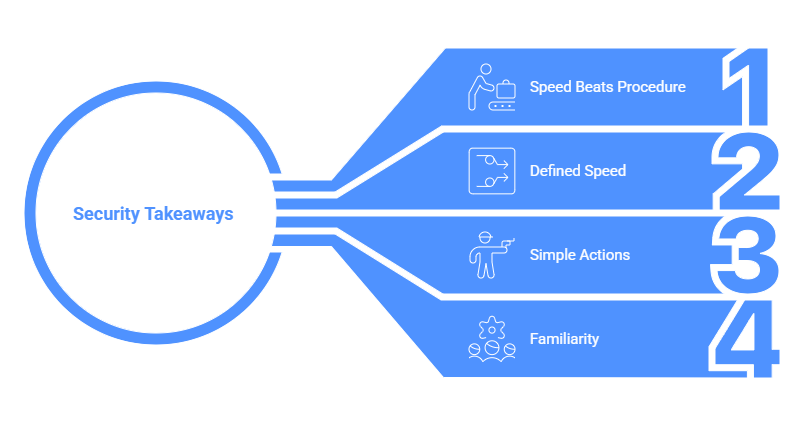
If the response depends on someone stopping to work through a checklist, you’re already behind. Surges happen. You have to expect them. The response needs to be built into the checkpoint itself, such as simple actions, clear triggers, and things people have practised. Something they can do straight away, without thinking it through step by step.
Speed only helps when triggers and roles are predefined. You need to know which choke points can be closed quickly, how queues are redirected, and what triggers escalation. That should not change depending on who’s on shift and fewer steps help, along with repetition. The first part of the response should feel familiar, even when things are busy.
2. Backstop human performance with systems
It’s a win that a bystander and TSA personnel stepped up in Atlanta. But relying on individual intervention under pressure does not scale. Civilian intervention worked here, but it’s not something you can depend on. It’s an unknown every time. The focus should be on reducing the extent to which individual performance under pressure drives outcomes. People need support from the system around them.
If detection is working properly, small issues are picked up early. That lets teams deal with the situation, rather than trying to notice it in the first place.
3. Design for containment when (not if) it breaks
A perfect perimeter security should not be assumed. The aim is to limit the impact when failures occur. Design needs to account for containment and isolation by using layers, clear choke points, and practical steps to close off zones when needed.
If the first layer is breached, the next point of control should be predetermined. The time required to isolate a zone, without affecting wider operations, is critical. Without this, a minor lapse can escalate into a broader disruption.
4. Close visibility gaps at handoff points
Perimeter fencing gets attention, but indoor transitions, queues, entry lanes, and handoffs often contain blind spots because these are the micro-perimeters where bad actors look for moments of friction to exploit.
If your cameras are positioned for general surveillance but miss the actual handoff points between security stages, you will lose continuity of security. To prevent exploits, visibility must be continuous. Once a person of interest is identified, they should remain trackable until intercepted.
5. Link alarms to cameras to dispatch, automatically
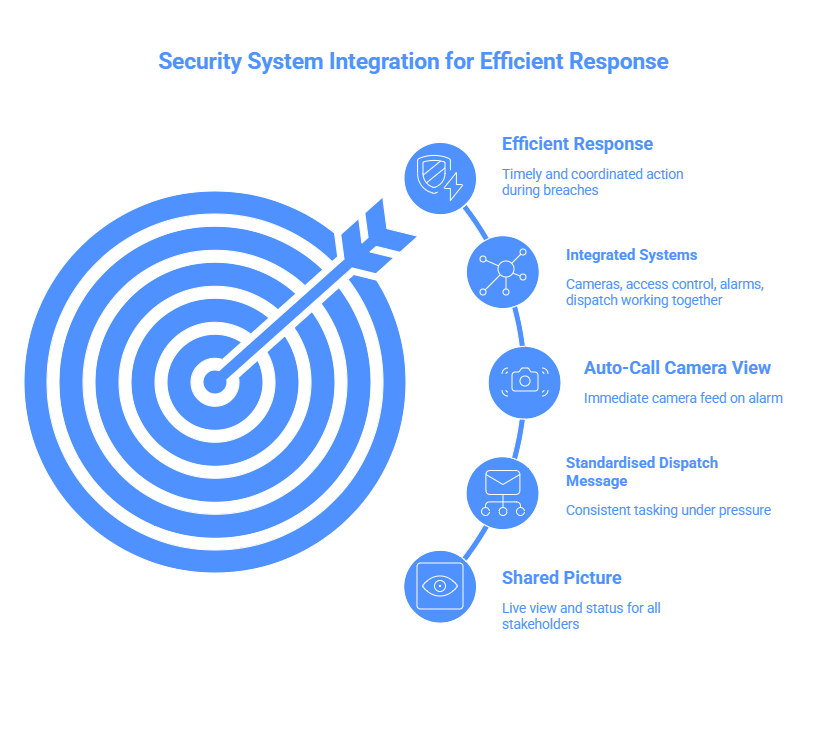
Operators cannot afford to move between systems during a breach. If cameras, alarms and access control are not connected, time is lost in small steps such as pulling up feeds, confirming locations, and relaying information that should already be visible.
The issue is not the alert itself. It is what happens immediately after. An alarm should bring up the relevant camera, with the location and direction of movement. The operator should confirm once, and that confirmation should move straight into dispatch tasking. If that chain requires manual steps or repetition, the response slows at the point it needs to accelerate.
Where systems are not aligned, the delay shows up in coordination. Operators spend time verifying what they are looking at. Dispatch works with partial information. Supervisors rely on updates rather than seeing the situation directly. The response still happens, but it lags behind the situation as it develops.
If you do only three things:
- Auto-call the right camera view on alarm, with location context attached.
- Standardise the dispatch message to ensure tasking remains consistent under pressure.
- Make supervisors and responders see the same picture (live view + status) without switching tools.
6. Drill the 30–90 seconds that shape the response
The first 30 to 90 seconds of a breach are chaotic. There’s conflicting info, crowd movement, and everyone trying to talk on the radio at once. This is the “messy middle” where most responses fall apart. You have to drill for this specific window of chaos. Practice comms discipline: who speaks first, who confirms location, and who tasks the response.
The shift from disturbance to breach needs a clear trigger. If those thresholds are not defined, escalation is delayed while people assess and reassess the situation.
Comms are where that delay becomes visible. If camera operators and dispatch are both talking at once or correcting each other, the channel slows. A fixed call structure prevents that, clear confirmation, followed by a structured tasking message.
Training should focus on execution, including who leads the call, what qualifies as “verified” in practice, which camera views are checked first, and what information dispatch needs before acting. The aim of the exercise is a response that holds together under load, especially when information is incomplete.
7. Run ground and airside security as one posture
A checkpoint breach is not isolated. It is part of the airport’s overall security posture. Airports face multi-domain risks that require monitoring, from checkpoint breaches to low-altitude drone activity near operational areas. Your architecture needs to reflect that reality.
The response principles do not change between them. Whether the threat is on the ground or in the air, the requirement is consistent: early detection, rapid verification, and a coordinated response that limits operational impact and prevents disruption from spreading.
What this means for Counter-UAS at airports
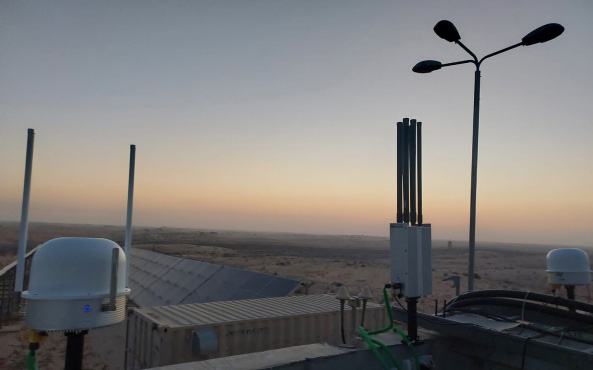
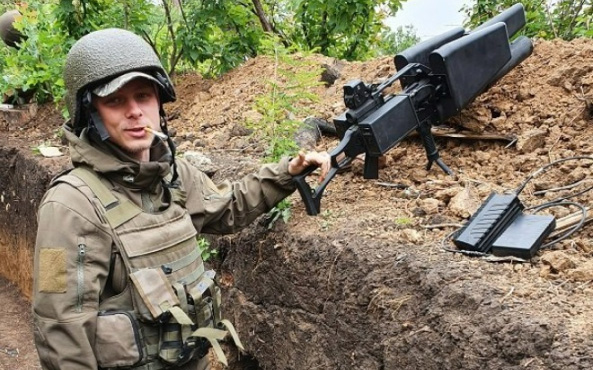
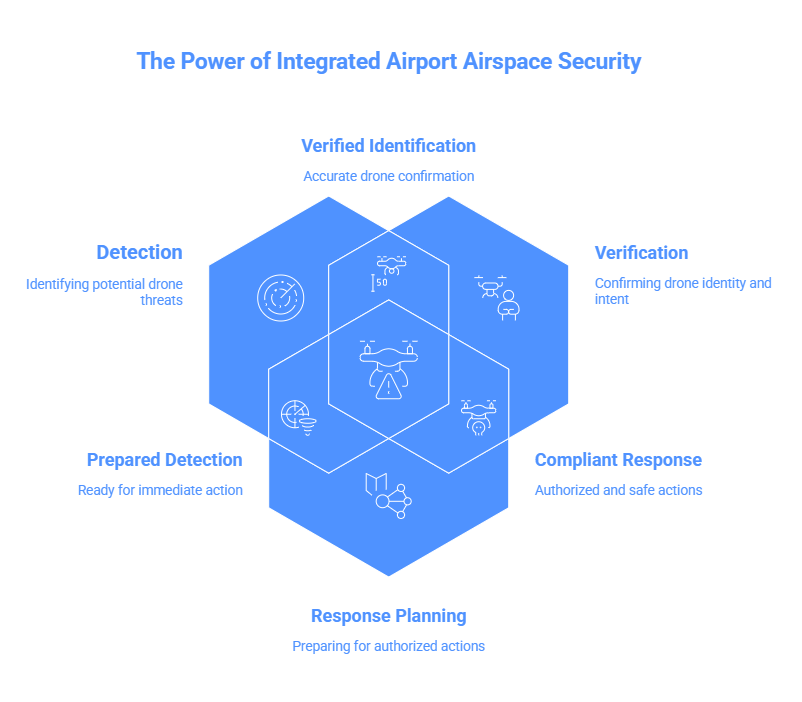
The same logic applies above the runway. Protecting an airport from drone threats requires layered detection, verification, and response planning, not a single tool. Effective airspace security is not a lone sensor purchase. It is a system that detects, verifies, and enables response options aligned with legal authority, ROE (where authorised), and site-specific safety constraints and operational regulations.
The operational goal is faster, verified identification with fewer false alarms. In an airport context, “verified” should be defined in advance. It means correlating the alert with sufficient confirmation to support a decision, such as cross-checking track data with visual observations, confirming the location relative to operational areas, and validating that the object is a UAS rather than clutter or benign activity. When verification is structured, you reduce unnecessary escalations and avoid dragging runway, apron, or terminal operations into a response cycle that was never warranted.
During an incident, alert volume that does not convert into actionable tasking becomes a liability.
This is where open-architecture C2/C4I integration matters most, connecting detection and verification into existing SOC, VMS, and dispatch workflows. Rather than treating drone detection as a “stovepipe” system tucked away in a corner, these feeds should integrate with existing security workflows in the SOC, dispatch, and VMS. When airspace awareness feeds into the daily command view, operators work from a single verified picture, with fewer handoffs and less time spent stitching data together under pressure.
Fix the Gaps Before They Fail Under Pressure
Incidents expose weak points, and the best thing to do is start by reviewing your choke points and containment plan. If the first layer is breached, the next move should already be defined and immediate. The delay usually comes after that, in the gap between alert and action. At the same time, the operating view has to stay aligned. Cameras, sensors and alarms should feed into a single shared picture so operators and responders aren’t working across separate tools. If they are, the system depends on people stitching it together under pressure, and that’s where the response slows.
This is where most environments break; systems detect, but they don’t coordinate. Skylock is built to integrate counter-UAS detection and verification into existing SOC/VMS and dispatch workflows, so drone alerts arrive with context and tasking-ready information.
If your system depends on people stitching things together under pressure, it’s already too late. SKYLOCK combines detection, verification, and response into a single operational workflow, so your team can act fast and with clarity when it matters most. Reduce decision time and contain disruption faster with SKYLOCK. Speak with one of our experts today.