The AI Delusion: Why Counter-Drone Systems Need More Than Just an Algorithm
 Stacy Dotan

The “Silver Bullet” Problem in Counter-UAS Systems
In the modern theater of security, drone threats are evolving at a velocity that consistently outpaces traditional defense mechanisms. The scale of the challenge is no longer theoretical; the severity of jamming and spoofing of aircraft GPS systems increased by an estimated 500% over the course of 2024 alone.
In response, much of the defense industry has pivoted toward Artificial Intelligence (AI) as a purported “silver bullet” within AI counter drone systems and broader C-UAS solutions. However, a critical strategic vulnerability is emerging: the belief that an algorithm alone can secure complex airspace.
While AI is an extraordinary force multiplier, treating it as a standalone solution rather than a component of a broader Counter-UAS (C-UAS) architecture is a dangerous miscalculation. To truly secure critical infrastructure, military bases, and sensitive airspace, we must bridge the cyber-physical gap where sophisticated code meets the unpredictable reality of the physical world.
AI in Counter-Drone Solutions Excels at Patterns but Fails at Context
Takeaway No.1
At its core, AI is an engine for high-speed pattern recognition, not a contextual decision-maker.
Modern counter drone systems can process thousands of data points to identify a drone anomaly faster than any human operator. However, they hit a “hard wall” when confronted with Rules of Engagement (ROE), safety constraints, and operational risk.
Identifying an object as a drone is a technical classification. Deciding whether to neutralize it in a high-stakes environment involves navigating a complex matrix of legal, operational, and safety consequences.
For example, a system-level decision to jam a signal near a civilian airport could interfere with legitimate aircraft communications or disrupt emergency services, outcomes that an algorithm alone cannot ethically or legally evaluate.
AI can detect and classify threats, but it cannot independently manage the legal, safety, and operational constraints that govern real-world Counter-UAS operations.
The Rise of Invisible Threats: Autonomous and GNSS-Denied Drones
Takeaway No. 2
A significant gap exists in many AI-driven Counter-UAS systems trained exclusively on traditional Radio Frequency (RF) detection patterns.
We are now seeing the rapid emergence of autonomous drones operating in GNSS-denied environments. These systems do not rely on continuous communication with a ground controller. Instead, they navigate using:
- Inertial navigation systems
- Onboard GPS
- Visual positioning and pre-programmed flight paths
Because they lack the drone-to-controller RF communication patterns that many counter drone technologies depend on, these threats can remain effectively invisible to RF-based detection systems. AI training data is inherently reactive, it only recognizes what it has seen before. As a result, custom-built drones, modified protocols, and emerging threat models can easily bypass systems built on static detection libraries.

Skylock’s Multi-Sensor Backbone
Takeaway No. 3
Skylock addresses this challenge by moving beyond the AI-only approach and implementing a multi-sensor Counter-UAS strategy. A single-sensor system creates a single point of failure. In contrast, layered counter-drone solutions create a resilient detection backbone:
- 3D Radar
Provides wide-area coverage, tracking movement, speed, and trajectory. Critical for detecting low-RCS (Radar Cross Section) targets, even those that may be “silent” to RF sensors. - RF Detection
Complements radar by listening to drone signal protocols and identifying control links early in the threat lifecycle, providing valuable electronic intelligence, although this is limited against autonomous, non-emitting threats. - EO/IR (Electro-Optical/Infrared)
Enables visual confirmation, target identification, and intent assessment capabilities that radar and RF alone cannot provide, allowing for definitive target identification and intent estimation.
This multi-layered detection architecture ensures that if a drone is undetectable by one sensor, it is captured by another- delivering high-confidence threat detection with minimal false alarms.
AI Fingerprinting: Identifying Unknown Drone Threats
Takeaway No. 4
To achieve true effectiveness in Counter-UAS systems, it is essential to distinguish between component-level AI and system-level intelligence.
At the component level, Skylock utilizes advanced algorithms within:
- Radar tracking and classification
- EO/IR target acquisition and identification
However, SkyLock’s key innovation lies in True AI Fingerprinting.
This is particularly critical for:
- Swarm detection scenarios-where the system must simultaneously process multiple signals and trigger alarms for coordinated attacks
- Coordinated drone attacks
- Unknown or modified UAV platforms
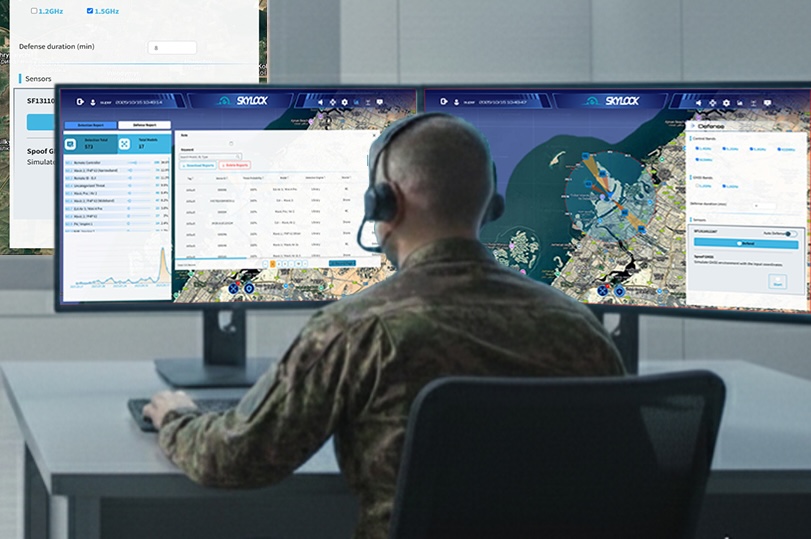
At the system level, this intelligence is fused within a unified C4i (Command, Control, Communications, Computers, and Intelligence) environment-creating a real-time operational picture with predictive threat analysis.
Decision Authority: The Missing Layer in Counter-Drone Architecture
Takeaway No. 5
Effective counter-drone systems are not defined by detection alone but by the architecture of response.
Detection without authority is operationally meaningless.
To enable effective real-world deployment, Counter-UAS solutions must integrate decision authority into their core design. Skylock’s integrated architecture is built on four critical pillars:
- Pre-defined Threat Profiles
Automated risk classification (low, medium, high) enabling proportional response - Rules of Engagement (ROE) Mapping
Ensuring every mitigation action from signal takeover to kinetic response aligns with legal and regulatory frameworks - Audit Trails and Forensic Logging
Creating a full record of detection, classification, and response decisions - Human-in-the-Loop (HITL)
Maintaining human authority over high-stakes decisions, particularly involving kinetic force or civilian airspace, while allowing automation to handle the operational tempo of detection.
This ensures that AI supports decision-making but never replaces command responsibility.
The Future of Counter-UAS Systems Is Integrated, Not Autonomous
The future of counter-drone systems lies in integration-not isolation.
The most effective Counter-UAS architectures for airspace security combine:
- Radar detection
- RF intelligence
- EO/IR verification
- Sensor fusion
- Decision frameworks
- Human oversight
Beyond the Algorithm
AI plays a critical role as an accelerator of detection, classification, and response speed but it cannot serve as the sole decision-maker. We must build architectures that support mission intent and legal compliance, not just pattern matching. As drone threats become more autonomous, adaptive, and complex, defense organizations must move beyond algorithm-centric thinking toward multi-layered, governed, and mission-ready counter-drone solutions.
The key question is no longer: But rather: “How resilient, integrated, and accountable is your Counter-UAS system?”