Operational Governance Framework: Decision Authority and Compliance in Autonomous C-UAS Systems
 Stacy Dotan
The Strategic Imperative: Building Resilient C-UAS Systems Beyond the AI “Silver Bullet”
In the contemporary theatre of electronic and kinetic warfare, autonomous C-UAS systems are increasingly shaped by the promise of Artificial Intelligence (AI), which is too often mischaracterized as a monolithic “silver bullet.” For the senior defense strategist, over-reliance on standalone AI, absent a rigorous governance framework, represents a profound operational liability that adversaries are already beginning to exploit.
While AI excels at rapidly processing vast volumes of data, it inherently lacks the contextual awareness required to navigate the legal, operational, and ethical nuances of kinetic engagement in complex, contested environments. Strategic resilience therefore demands a shift away from AI-centric models toward governance-first architecture, where digital inference is anchored in multi-sensor truth and established legal authority.
The Context Gap: Why Pattern Recognition is Insufficient for Defense
The “Cyber-Physical Gap” occurs when digital pattern recognition fails to translate into real-world situational awareness, creating a strategic vulnerability in several key areas:
- Training Data Limitations:
AI models are historically bounded; they recognize only what they have been explicitly taught. Custom-built drones or modified communication protocols often fall outside known libraries, rendering AI-only detection blind to novel threats. - Evasive Tactical Manoeuvres: Adversaries utilize low-altitude flight, terrain masking, and the manipulation of Radar Cross Sections (Low-RCS) to confuse models conditioned on conventional flight behaviours.
- Pre-programmed Autonomy: Sophisticated threats now utilize inertial navigation, onboard GPS, or visual sensors to operate without constant RF control links. This eliminates the drone-to-controller signal patterns that many AI detectors rely upon for identification.
- Absence of Situational Judgment: AI lacks the capacity to evaluate the “intent” behind a flight path or the potential for catastrophic collateral consequences in high-density civilian or military zones. This context gap is far more than a technical oversight—it is a strategic liability that can compromise national security and mission effectiveness. To safeguard operations, next-generation C-UAS platforms must evolve beyond simple pattern recognition, adopting resilient architectures that seamlessly integrate high-fidelity sensors with robust, legally compliant software governance.
The Multi-Sensor Detection Backbone: Establishing Ground Truth
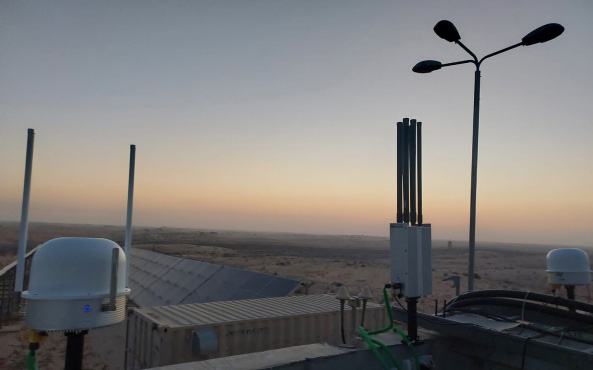
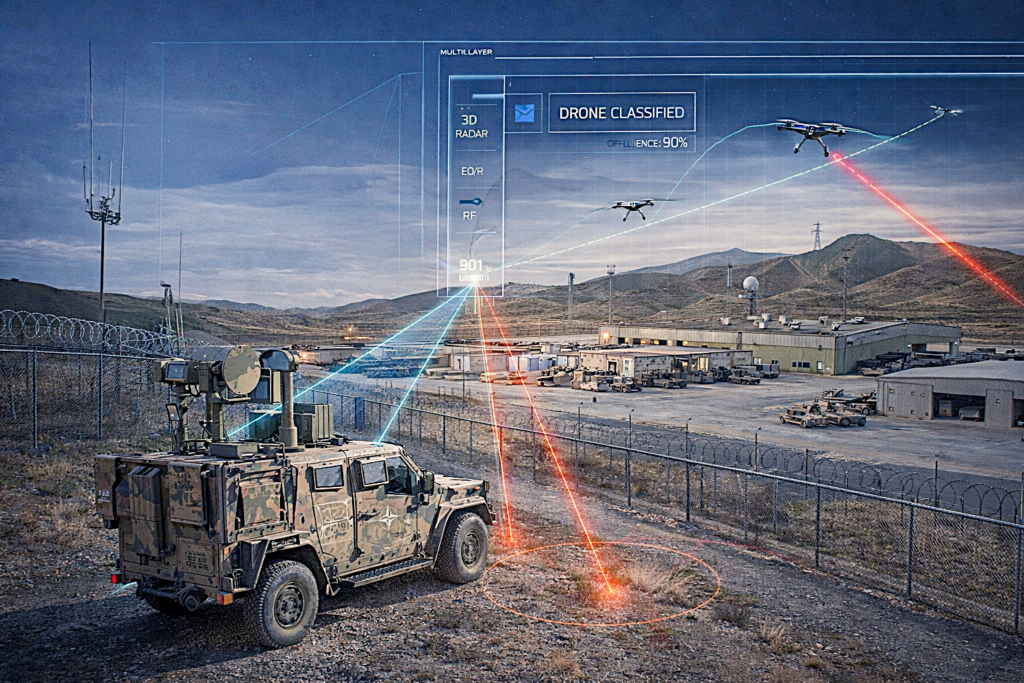
Reliable operational governance of C-UAS systems depends on establishing an authoritative “ground truth”—a single, verifiable reality created by synthesizing data from multiple sensor sources. Leading defense architects recognize that no single sensor can provide complete coverage. Effective counter-drone defense demands a layered, multi-sensor approach in which each sensor type corroborates and validates the others, overcoming both environmental noise and adversarial deception.
Multi-Mode Detection Matrix
| Sensor Type | Capabilities | Operational Limitations |
| Radar | Wide-area coverage; tracks movement, speed, and vector; detects low-RCS targets. | Low-altitude blind spots; terrain masking; struggles in GNSS-denied environments without augmentation. |
| RF Detector | Protocol deconstruction; identifies control links early; provides electronic “fingerprints. | Dependent on active emissions; vulnerable to radio-silent threats or alternative comms. |
| EO/IR | High-resolution visual confirmation; utilized for search, recognition, and identification (DRI). | Requires line-of-sight; severely degraded by atmospheric conditions (fog, rain, smoke). |
The SkyLock system leverages this backbone through True AI Fingerprinting, which performs RF-level deconstruction to identify unknown drones.
Unlike library-dependent systems, this capability enables the identification of threats based on their unique electronic signatures, even when no pre-existing signature exists in the database.
When combined with specialized swarm detection, this resilient detection backbone provides the technical evidence required for lawful classification and response.
Fused Classification and Predictive Threat Assessment
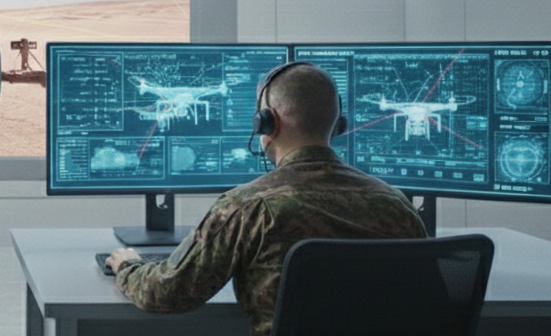
In this framework, AI functions as a “Strategic Accelerator.” It synthesizes vast sensor streams into actionable intelligence, ensuring that detection leads to high-confidence classification without usurping final decision authority.
The Intelligence Pipeline
- Component-Level AI (EO/IR & Sensor Specifics):
- Detection: Rapidly isolating an anomaly within the sensor field.
- Recognition: Determining if the anomaly is a biological entity, debris, or a UAV.
- Identification: Pinpointing the specific model, payload, and potential origin using high-resolution visual and RF data.
System-Level Functions (C4i Orchestration)
- Unified Multi-Layer Integration: The C4i system synthesizes 3D Radar, EO/IR, and RF data into a single, real-time situational picture.
- Predictive Decision Support: Machine learning pre-empts threats by forecasting flight paths and scoring behavioral intent, allowing operators to visualize breaches before they occur.
- Autonomous Countermeasure Advising: The AI validates the optimal power levels and interception modes (e.g., jamming vs. takeover), providing a “one-click” advisory to the operator.
- By automating the “recognition” and “advisement” phases, the system significantly reduces operator cognitive strain while maintaining the essential requirement for human-mediated validation.
Key Takeaways
- Autonomous C-UAS systems should move beyond viewing AI as a ‘silver bullet’ and adopt a governance-first architecture.
- AI alone lacks context for legal and ethical decision-making in warfare, creating strategic vulnerabilities.
- A multi-sensor detection approach ensures reliable operational governance by synthesizing information from various sources.
- AI can enhance decision-making but must operate within established rules of engagement and legal frameworks.
- Future C-UAS effectiveness relies on integrating AI into resilient systems that preserve accountability and human oversight.
The Decision Authority Architecture: ROE and Legal Compliance
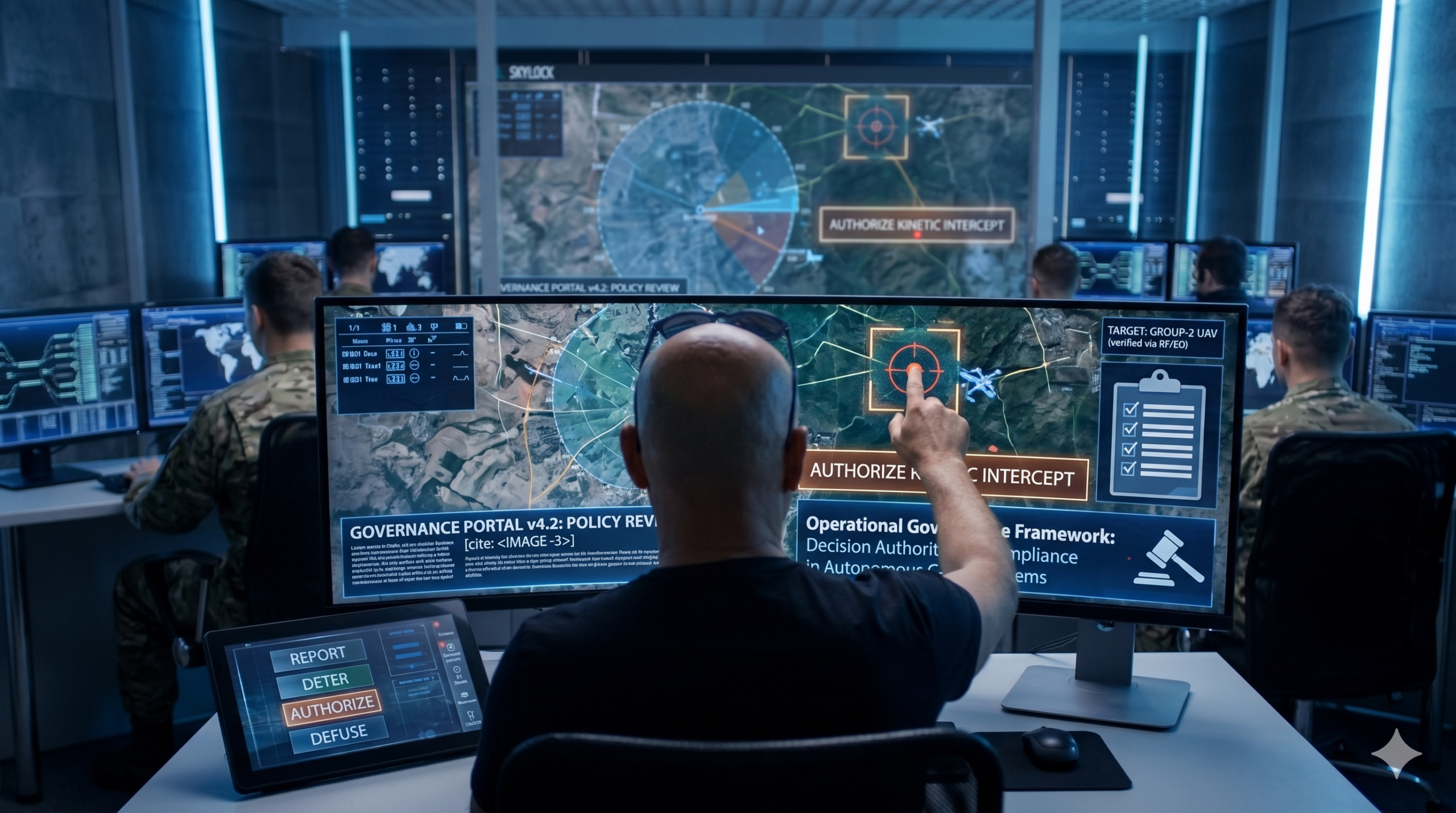
Detection without authority is strategically meaningless. In the modern theater, where GPS and RF spoofing have increased by an estimated 500%, the risk of Automated Fratricide or civilian collateral damage is at an all-time high. AI cannot be the sole arbiter of force; rather, it must operate within a decision architecture that hard-codes Rules of Engagement (ROE) and national legal frameworks.
The Four Pillars of Authorized Defense Architecture
Pre-defined Threat Profiles & Escalation Matrices:
Threats are automatically categorized by risk level (low/medium/high), ensuring that the defensive response is proportional and pre-authorized.
ROE-Compliant Response Options:
Every action from non-kinetic jamming to protocol takeover or kinetic interception is mapped to specific legal mandates to prevent jurisdictional overreach.
Safety and Collateral Risk Mitigation:
The system evaluates the environmental impact of a response, such as whether jamming will disrupt critical airport communications or if kinetic debris poses a risk to civilian bystanders.
Human-in-the-Loop (HITL) Mandates:
While automation handles routine monitoring, human operators retain final authority over high-stakes kinetic decisions, ensuring that command responsibility is never abdicated to an algorithm.
Operational Protocols: Ensuring Accountability and Audit Trails
For a defense system to be “field-ready,” it must be capable of surviving post-incident legal and sovereign review. The “Audit Trail” is the mechanism by which a nation-state defends its actions on the international stage, proving that its use of force was justified and proportional.
Operational Protocols: Ensuring Accountability and Audit Trails
For a defense system to be “field-ready,” it must be capable of surviving post-incident legal and sovereign review. The “Audit Trail” is the mechanism by which a nation-state defends its actions on the international stage, proving that its use of force was justified and proportional.
Forensic Logging Requirements
To maintain Sovereign Defense standards, the system must produce an immutable record of:
- Detection Events: Raw sensor data and timestamps of the initial alert.
- Classification Confidence Levels: The statistical probability assigned during identification.
- Logic for Response Advisement: The specific ROE parameters and logic trees utilized by the AI to recommend a countermeasure.
- Human Authorisation Timestamp: The definitive record of the operator’s review and final command.
- These protocols bridge the gap between experimental technology and mission-effective defense. They ensure that the speed of AI is balanced by the accountability of a professional military or security force.
Final Thoughts
Implementation Summary: Integrated C-UAS Strategy for Modern Defense Operations
The future of C-UAS lies not in “smarter” standalone AI but in integrating AI into a resilient, multi-sensor, lawfully governed architecture. True defense effectiveness is the product of high-fidelity data fusion, pre-authorized decision logic, and real-time human command.
The Governance Model Summary
The distinction is decisive: when AI is treated as a replacement for command judgment, it becomes a liability-limited by isolated pattern matching, blind to context, exposed to spoofing, and incapable of carrying legal authority.
When AI is deployed as an enhancer within a governance-first architecture, it becomes a force multiplier, synthesizing multi-sensor truth, accelerating human decision loops, operating within established ROE, and preserving full forensic accountability.
This is the model that will define effective modern C-UAS: Radar and RF detection, fused sensor intelligence, and pre-authorized response frameworks working together to protect lives, infrastructure, and sovereign legitimacy in real time.